
Recall Fidelity in the Age of Generative Engines
The integration of large language models (LLMs) into search interfaces has transformed the dynamics of digital visibility. This paper introduces recall fidelity as a measurable construct and explores strategies for achieving consistent recall in AI-generated responses.
Introduction: The Generative Recall Challenge
Generative engines now mediate the majority of AI-powered information queries, shifting from ranked retrieval to synthesized answers. In this paradigm, sources are often paraphrased, reframed, or omitted entirely, leading to a new class of visibility risk: degraded recall. Unlike classical search, where inclusion implied presence, generative systems compress and abstract information — sometimes introducing hallucinations or misattributions.
Recent benchmarking from Vectara's Hallucination Evaluation Leaderboard (2025) illustrates the variance in hallucination rates among popular answer engine models. The figures below reflect a snapshot as of April 2025 and will evolve as models are retrained and updated:
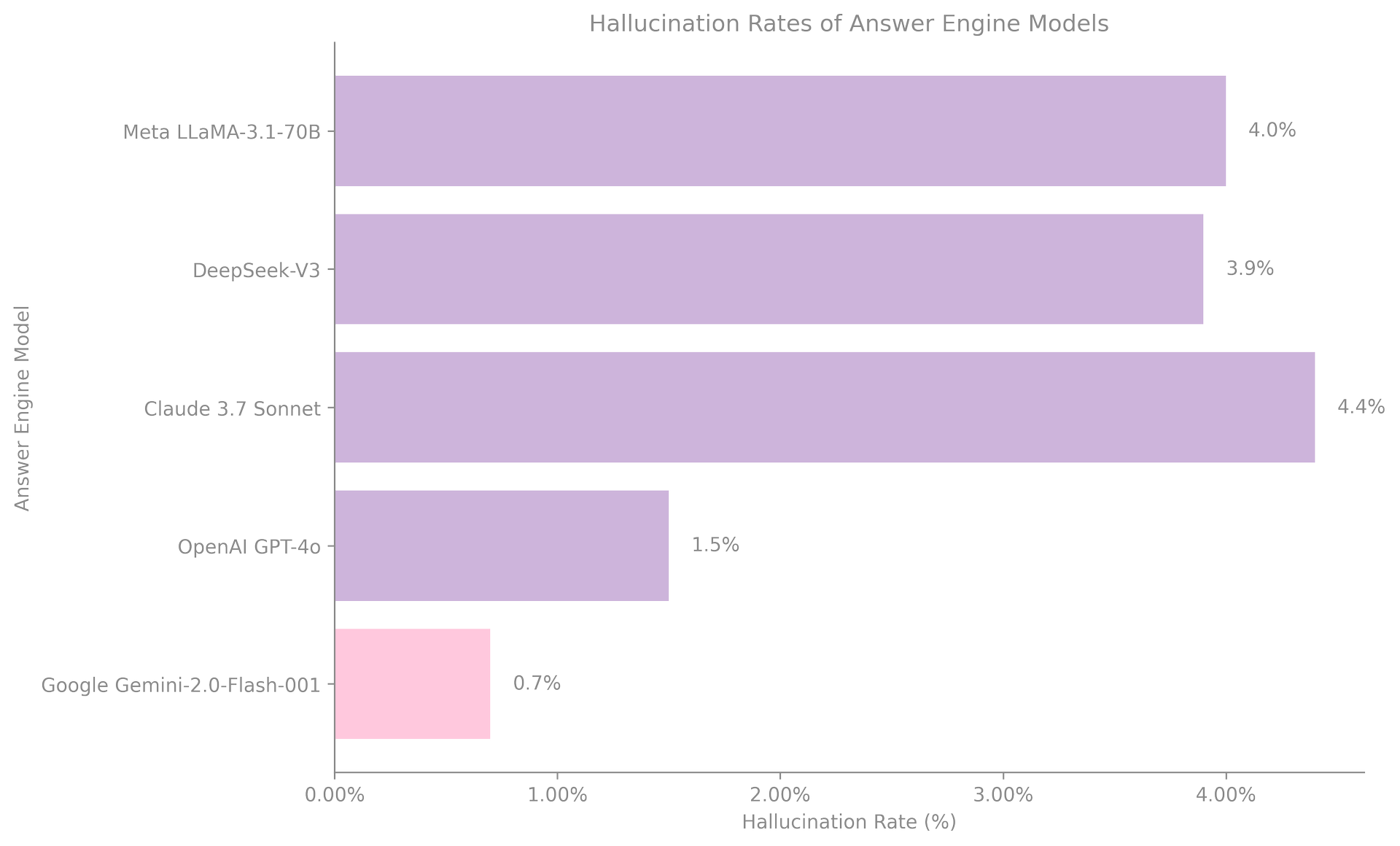
As of April 2025, hallucination rates vary significantly across leading LLMs: Google Gemini-2.0-Flash at 0.7%, OpenAI GPT-4o at 1.5%, Claude 3.7 Sonnet at 4.4%, DeepSeek-V3 at 3.9%, and Meta LLaMA-3.1-70B at 4.0%
- Google Gemini-2.0-Flash-001: 0.7% hallucination rate, 99.3% factual consistency
- OpenAI GPT-4o: 1.5% hallucination rate, 98.5% factual consistency
- Claude 3.7 Sonnet: 4.4% hallucination rate, 95.6% factual consistency
- DeepSeek-V3: 3.9% hallucination rate, 96.1% factual consistency
- Meta LLaMA-3.1-70B: 4.0% hallucination rate, 95.9% factual consistency
These results demonstrate that while top-tier models outperform predecessors, hallucination and citation drift still occur even in high-performing systems. Thus, visibility in generative contexts demands engineered observability and content-level intervention.
GPT-5 (high) shows a 1.0% hallucination rate on the LongFact-Concepts benchmark without tools, compared to 0.7% for GPT-4.1 (long-context).
OpenAI’s latest system card compares frontier models on LongFact-Concepts and reports GPT-5 at 1.0% hallucination without tools, slightly above GPT-4.1 in the same setup. Even newest-generation models still need grounding safeguards in production RAG pipelines.
Gemini 3 Pro scores 91.9% on the GPQA Diamond scientific reasoning benchmark, leading frontier models as of November 2025.
A reproducible GPQA Diamond run shows Gemini 3 Pro at 91.9%, ahead of GPT-5.1 (88.1%) and Claude Sonnet 4.5 (83.4%). GPQA Diamond stresses graduate-level, Google-proof science questions, making it a strong proxy for complex reasoning fidelity.
Claude Sonnet 4.5 reaches 61.4% on the OSWorld real computer-use benchmark, up from 42.2% for Sonnet 4.
Anthropic’s release notes document the OSWorld gains, showing that targeted tool-use and computer-control tuning materially improve grounded task execution—an important signal for applied reliability beyond text-only QA.
Defining Recall Fidelity and Drift Types
We define recall fidelity as the likelihood that a model retrieves and regenerates a specific knowledge unit with correct attribution and preserved context. It operates on four primary axes:
| Layer | Description |
|---|---|
| Retrievability | Can the model access the source via internal weights or external RAG? |
| Attribution | Is the original source properly credited or cited? |
| Framing Integrity | Is the original context (intent, scope, limitations) preserved? |
| Temporal Validity | Is the information still accurate within its intended time window? |
Drift Types:
- Lexical Drift: The content is paraphrased in a way that reduces precision.
- Attribution Drift: The citation is omitted, generalized, or misassigned.
- Semantic Drift: The meaning of the original claim is altered or contradicted.
These forms of degradation threaten the factual integrity and traceability of generative outputs.
Observability Through Prompt Probing and Monitoring
To monitor recall fidelity, we introduce a probing protocol:
- Define a set of canonical knowledge units (e.g., "The ROI of coaching is 7x according to ICF").
- Create 2–3 natural language prompt variants per knowledge unit.
- Query selected LLMs (e.g., GPT-4o, Claude 3.7, Gemini) at regular intervals.
Example Probe Log Entry:
prompt: "What is the average ROI of leadership coaching?"
model: "GPT-4o"
response: "Some experts say coaching has a 5x to 8x ROI."
retrievability: pass
attribution: partial
framing: pass
temporal_validity: pass
drift_detected: attribution_drift
This framework enables structured monitoring and can be scaled using tools like LangChain, PromptLayer, or custom logging pipelines.
Corrective Feedback Loops and Optimization Strategies
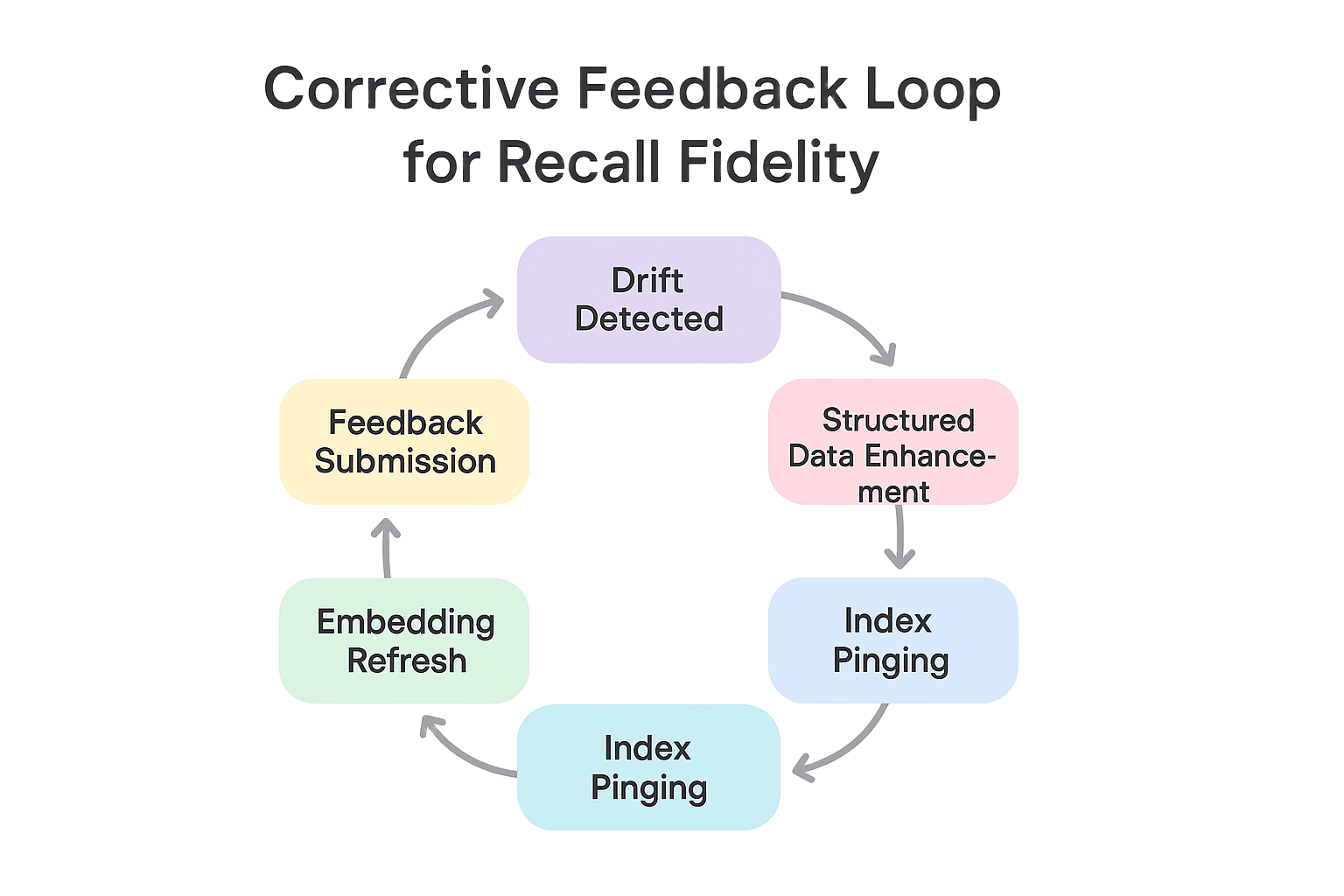
Once drift is detected, corrective actions should follow a structured loop:
- Content Refresh: Update or clarify the source page.
- Structured Data Enhancement: Add schema.org markup to increase machine readability. (See Architecting Citability in the Generative Web for detailed strategies on structured metadata and modular knowledge units.)
- Index Pinging: Use protocols like IndexNow to notify engines of updates.
- Embedding Refresh: Recompute vector embeddings in RAG systems.
- Feedback Submission: Leverage OpenAI, Anthropic, or Gemini feedback APIs.
Studies and platform documentation (SchemaApp, CMSWire, 2024–2025) affirm that structured markup improves LLM comprehension and retrieval alignment.
Conclusion
LLMs do not recall uniformly. Recall fidelity must be engineered. Organizations seeking durable visibility in AI interfaces must go beyond traditional SEO and adopt recall-centric optimization. This includes structured content, monitoring tools, prompt benchmarking, and model feedback. As AI-generated answers become a dominant interface for knowledge access, citation transparency, fidelity tracking, and contribution to open standards will be key to information integrity.
- Even top AI models like Gemini (0.7%) and GPT-4o (1.5%) still produce hallucinations, requiring content optimization strategies
- Structured data markup (schema.org) significantly improves LLM comprehension and retrieval alignment
- Content refreshes, index pinging, and feedback APIs are essential corrective measures to maintain visibility in AI responses
References
-
Ji, Z., et al. (2023). A Survey on Hallucination in Large Language Models. arXiv:2305.17888. https://arxiv.org/abs/2305.17888
-
Guo, B., et al. (2024). An Empirical Study on Factuality Hallucination in Large Language Models. arXiv:2401.03205. https://arxiv.org/abs/2401.03205
-
Liu, J., et al. (2023). Retrieval-Augmented Generation for Large Language Models: A Survey. arXiv:2312.10997. https://arxiv.org/abs/2312.10997
-
Zhou, Q., et al. (2024). Temporally Consistent Factuality Probing for LLMs. arXiv:2409.14065. https://arxiv.org/abs/2409.14065
-
Wang, Y., et al. (2024). Factuality of Large Language Models. EMNLP 2024. arXiv:2402.02420. https://arxiv.org/abs/2402.02420
-
Maheshwari, H., Tenneti, S., & Nakkiran, A. (2025). CiteFix: Enhancing RAG Accuracy Through Post-Processing. arXiv:2504.15629. https://arxiv.org/abs/2504.15629
-
Vectara. (2025). Hallucination Evaluation Leaderboard. Hugging Face Spaces. https://huggingface.co/spaces/vectara/Hallucination-evaluation-leaderboard
-
Dehal, R. S., Sharma, M., & Rajabi, E. (2025). Knowledge graphs and their reciprocal relationship with large language models. Machine Learning and Knowledge Extraction, 7(2), 38. https://doi.org/10.3390/make7020038