
AEO vs. SEO: Key Differences and How Enterprise Teams Should Adapt Their Strategy
Discover the key differences in AEO vs SEO, understand AI citation ranking factors, and learn how enterprise teams can build a winning hybrid strategy.
AEO vs. SEO: Key Differences and How Enterprise Teams Should Adapt Their Strategy
Introduction
Enterprise SEO teams are encountering a situation with no clear precedent: the organic traffic channel they have optimized for decades is being supplemented — and in some query categories, supplanted — by AI-generated answers that do not reward the highest-ranking keyword strategy. When a procurement manager asks ChatGPT to recommend an enterprise analytics platform, no amount of backlink velocity or title tag optimization determines which brand gets cited. A fundamentally different set of signals governs that outcome.
This divergence is not a future concern — it is already visible in enterprise dashboards. Research from Gartner projects that traditional search engine volume will decline by 25 percent by 2026 as consumers shift to AI-powered answer engines. For enterprise marketers and SEO specialists, the strategic question is no longer whether to invest in Answer Engine Optimization (AEO) alongside traditional SEO, but how to structure that investment and measure its return. This post provides a clear framework for both.
What Is the Core Difference Between SEO and AEO?
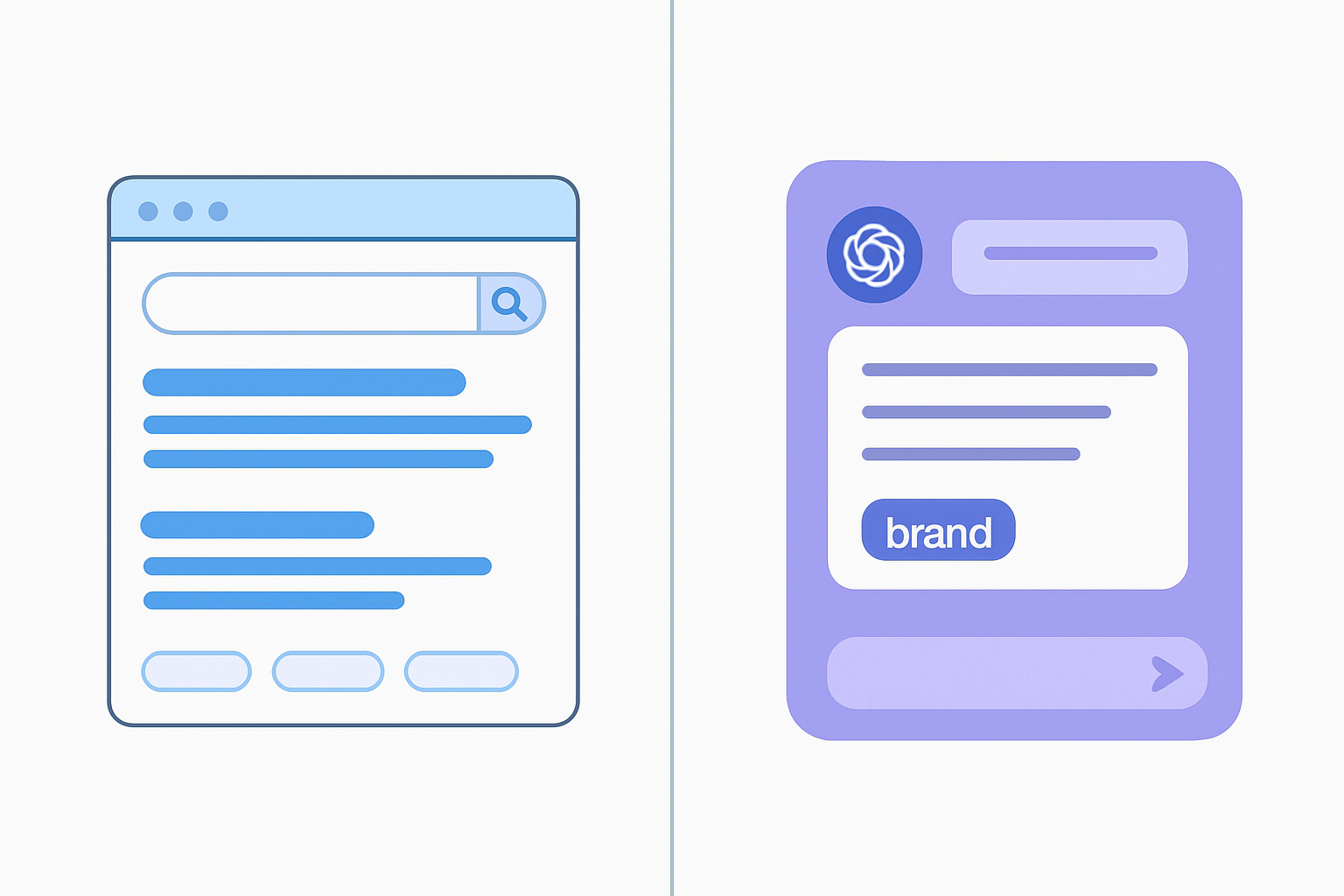
SEO and AEO operate on fundamentally different models of visibility: SEO competes for ranked positions in a list of links, while AEO competes for inclusion in a direct, synthesized answer. Understanding this distinction is the foundation of any rational resource allocation decision for enterprise teams.
Traditional search engine optimization is built around a ranked results page. The goal is to secure one of the top positions for a target query, primarily through signals such as keyword relevance, domain authority, page speed, and inbound link quality. Success is measured in impressions, click-through rates, and organic sessions — all tied to users choosing to click a link to your property.
Answer Engine Optimization, by contrast, targets a different output entirely. Platforms such as ChatGPT, Google Gemini, Perplexity, and Anthropic's Claude do not return a ranked list of links. They generate a synthesized response that may reference, recommend, or cite specific brands as part of the answer. There is no position one or position ten — there is either presence in the answer or absence from it. For a deeper introduction to what AEO entails, the Answer Engine Optimization Complete Guide provides comprehensive coverage of the discipline's foundations.
The operational implications of this difference are significant. SEO optimization operates on a relatively stable technical playbook: crawlability, Core Web Vitals, structured markup, and content relevance signals. AEO operates on a more fluid set of factors related to how AI models perceive and represent brand authority, topical expertise, and trustworthiness — factors that were never designed with traditional search ranking in mind.
This is where generative AI SEO emerges as a distinct practice area. Rather than chasing algorithmic ranking factors, it demands that teams think about how a large language model would construct an answer to a buyer's question and whether your brand's content, credibility, and structured presence are sufficient to warrant inclusion in that answer.
Key takeaway: The shift from SEO to AEO is not incremental — it requires enterprise teams to build an entirely new capability layer alongside their existing search practice, not simply extend their current workflow.
AEO vs SEO: How AI Answer Engines Select Brands and Rank Citations
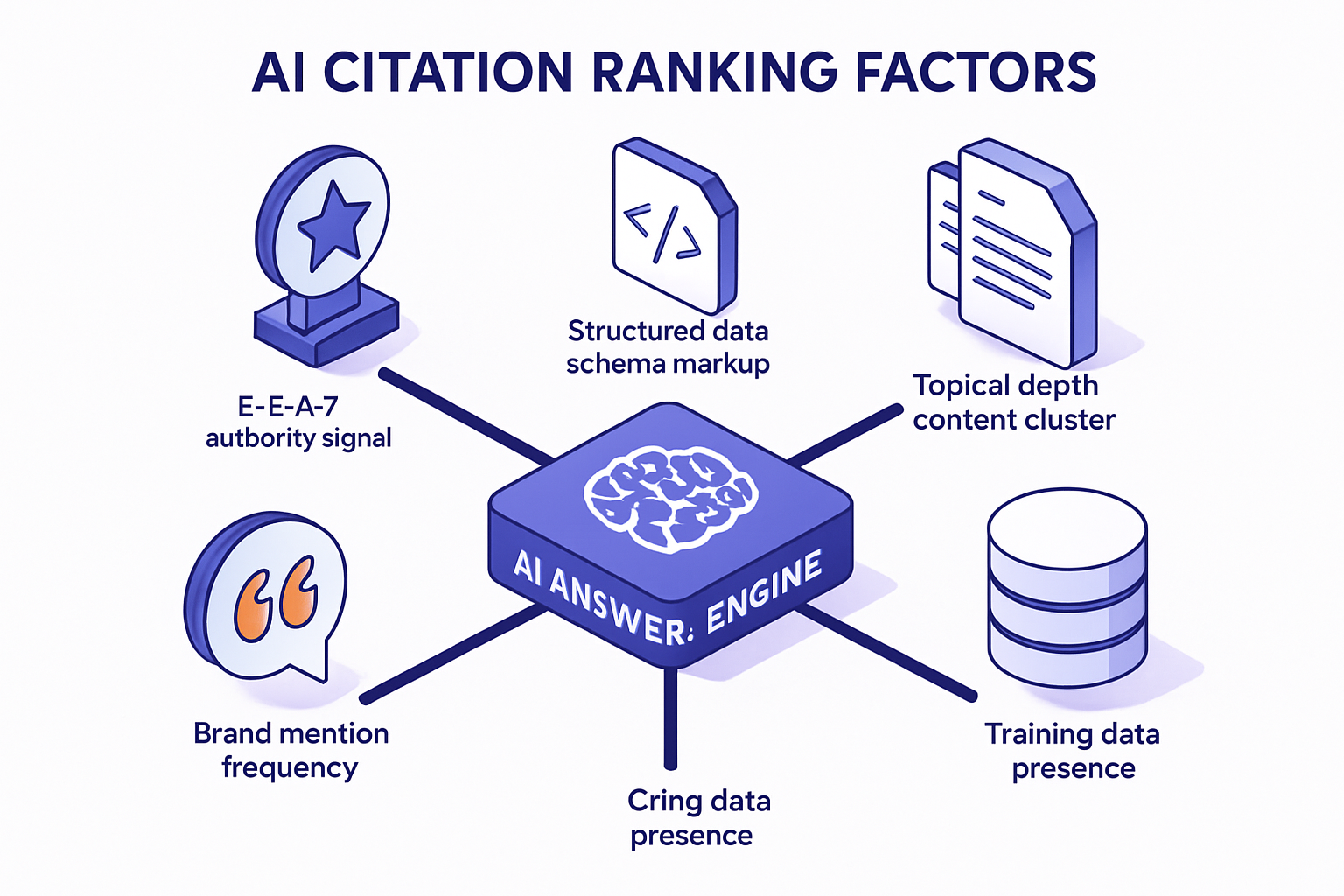
AI answer engines do not evaluate brands using the same ranking signals as traditional search engines; they weight authority, topical depth, E-E-A-T signals, and structured data presence in ways that require a distinct optimization approach. Understanding the AI citation ranking factors is essential before allocating any enterprise budget to this channel.
Traditional search ranking factors are well-documented: domain authority, keyword relevance, page experience signals, and inbound link quality remain central. AI answer engines draw on a different set of inputs. While the specific mechanisms vary by platform, research and practitioner observation point to several consistent patterns in how these factors operate:
Topical authority and depth. AI models weight brands that demonstrate comprehensive, authoritative coverage of a subject domain. A brand with a handful of shallow pages on a product category will typically be cited less frequently than one with a structured content cluster covering the topic from every relevant angle — use cases, comparisons, technical implementation, and buyer education. This is the single most important structural investment for teams building an answer engine optimization strategy.
E-E-A-T signals. Experience, Expertise, Authoritativeness, and Trustworthiness — the framework Google introduced for human quality raters — appears to influence how AI models assess source credibility. Content attributed to named experts with verifiable credentials, published on domains with strong editorial standards, tends to surface more consistently in AI-generated recommendations.
Structured data and schema markup. Machine-readable markup helps AI systems extract and categorize brand information with precision. Organization, Product, FAQ, and HowTo schemas give AI models explicit signals about what a brand does, who it serves, and what problems it solves — reducing the ambiguity that causes brands to be omitted from relevant answers.
Brand mention frequency and co-occurrence. AI language models are trained on large corpora of web content. Brands that appear frequently alongside relevant industry terms, that are discussed in third-party publications and forums, and that are cited in authoritative sources tend to develop a stronger representational presence in model weights. This is a dimension of AI search optimization for enterprise that has no direct equivalent in traditional SEO — and one that requires active monitoring to manage.
Unlike SEO, where ranking movements can be tracked in Google Search Console within days, AI citation monitoring requires dedicated tooling. Platforms like Mentionary are built specifically to measure how often and in what context a brand is cited across ChatGPT, Claude, Gemini, and Perplexity — providing the visibility layer that traditional SEO tools cannot offer. The Definitive Guide to AI Visibility offers a comprehensive overview of how to structure that monitoring function at the enterprise level.
Key takeaway: AI citation ranking factors reward topical authority, E-E-A-T, structured data, and brand presence in training data — signals that require a different content investment model than traditional keyword-driven SEO.
Building a Hybrid Enterprise Strategy: Allocating Resources Across SEO and AEO
Enterprise teams that treat AEO as a replacement for SEO will underinvest in organic traffic; those that treat it as irrelevant will cede brand presence in the fastest-growing discovery channel — the correct approach is a coordinated hybrid strategy with distinct measurement frameworks for each discipline.
The practical starting point is recognizing where SEO and AEO investments overlap and where they diverge. Several content investments serve both channels simultaneously, making them the highest priority for enterprise budget allocation in 2026:
Pillar content and topic clusters. Deep, comprehensive content on core topic areas strengthens both traditional organic rankings and AI topical authority signals. An enterprise team that builds a well-structured content cluster around a product category creates assets that perform in blue-link search results and that provide the topical depth AI models look for when deciding which brands to recommend.
Structured data implementation. Schema markup benefits both channels. For SEO, it enables rich results. For AEO, it provides AI models with machine-readable context about the brand's offerings, expertise, and trust signals. This is one of the highest-ROI technical investments for teams operating across both disciplines, and it requires no additional content creation — only implementation effort.
E-E-A-T reinforcement. Author bios, expert attribution, editorial standards documentation, and third-party press coverage all contribute to both Google's quality assessments and AI model authority signals. Building a credible editorial identity serves the hybrid strategy directly, with compounding returns over time.
Where SEO and AEO diverge, enterprise teams need dedicated resource tracks. For the AEO channel specifically, this means investing in brand monitoring across AI platforms, identifying citation gaps relative to competitors, and producing content that directly addresses the question formats AI systems are likely to synthesize. The Enterprise Guide to Generative Share-of-Voice details how to measure AI citation performance at scale and define meaningful KPIs for this emerging channel.
On the measurement side, enterprise teams should maintain parallel dashboards: traditional organic traffic, keyword ranking distributions, and click-through rates for SEO performance; and Generative Share-of-Voice, citation frequency by platform, and competitor citation benchmarks for AEO. These are fundamentally different metrics, and conflating them leads to poor decisions about where to allocate incremental budget.
A practical phased approach for enterprise teams involves three stages. In the first stage, establish a baseline by auditing current AI citation frequency across relevant query categories using a dedicated monitoring platform. In the second stage, identify citation gaps — queries where competitors are cited and your brand is absent — and map them to specific content and authority-building investments. In the third stage, optimize iteratively, using Generative Share-of-Voice as the primary AEO KPI while maintaining or improving existing SEO performance through continued technical and content investment. For teams seeking to identify content opportunities that serve both channels simultaneously, the AI-Powered Content Gap Analysis guide provides a practical methodology for surfacing those high-value topics.
Key takeaway: The highest-performing hybrid strategies invest first in shared assets — topic clusters, structured data, E-E-A-T signals — while maintaining dedicated measurement tracks and targeted content investments for AEO specifically, ensuring neither channel is optimized at the expense of the other.
Conclusion
The AEO vs SEO question is not a binary choice for enterprise teams — it is a portfolio allocation problem. Traditional SEO remains a critical driver of measurable organic traffic, and its core practices of technical optimization, content quality, and link authority are not obsolete. They are, however, no longer sufficient to ensure brand presence across the full discovery journey of an enterprise buyer who increasingly begins their research with an AI assistant rather than a search engine.
The enterprises that will build durable brand authority over the next three years are those that establish an AI search optimization infrastructure today: monitoring citation frequency, benchmarking against competitors, investing in topical depth, and measuring Generative Share-of-Voice with the same rigor they bring to traditional organic performance. Mentionary is purpose-built for exactly that function — providing the enterprise-grade visibility and benchmarking infrastructure needed to execute a coordinated AEO strategy at scale, across every major AI answer platform.