
How to Get Your Brand Cited in ChatGPT: A Step-by-Step Optimization Guide
Learn how to get cited in ChatGPT with a seven-step optimization plan — covering entity signals, third-party authority sources, and content strategy for 2026.
Your brand shows up in a Perplexity answer — but when a buyer opens ChatGPT and asks the exact same question, your competitor's name appears instead of yours. That gap exists because ChatGPT and Perplexity use fundamentally different citation mechanisms, and most optimization guides treat them as interchangeable. They aren't.
Understanding how to get cited in ChatGPT starts with understanding what the platform actually does when it selects a brand to recommend. This guide gives you a concrete seven-step plan — grounded in how ChatGPT's citation logic actually works in 2026 — to measurably improve your brand's visibility in ChatGPT answers.

What It Actually Means to Be Cited in ChatGPT
A ChatGPT citation is when the model surfaces your brand name, product, or URL in a user's answer — drawing on entity patterns learned during training or, for commercial-intent queries, real-time web retrieval. Unlike a traditional search ranking, there is no visible position number, no bid mechanism, and no guaranteed placement. ChatGPT surfaces only 3–4 brands per response on average, according to research by Onely — meaning being omitted is the default state for the vast majority of brands in any given category.
That scarcity is what makes ChatGPT citation optimization both urgent and high-value. First Page Sage's April 2026 market share data shows ChatGPT holding 60.6% of the AI chatbot market — more than four times Gemini's share and more than eleven times Perplexity's. When a buyer asks an AI assistant which CRM, which SaaS tool, or which agency to consider, they are most likely asking ChatGPT. The brand that gets cited in that answer wins the consideration.
If you are already monitoring your current ChatGPT visibility, the ChatGPT brand monitoring guide covers how to establish baseline awareness before running structured optimization. This post picks up where monitoring leaves off: what to actually change.
How ChatGPT Chooses Brands to Mention — And Why It Differs from Perplexity and Gemini
ChatGPT selects brands primarily through entity patterns embedded during training, not through live-web retrieval for every query. This is the critical structural difference from Perplexity, which queries the live web for every answer, and from Gemini, which leans on Google's search index. Understanding the mechanics per platform tells you which levers to pull.
| Dimension | ChatGPT (GPT-4o) | Perplexity | Gemini |
|---|---|---|---|
| Primary data source | Training corpus + selective web search | Real-time web retrieval (every query) | Google Search index + training data |
| Brands cited per response | 3–4 (highly selective) | ~13 (broad sourcing) | ~8 (moderate) |
| Live web browsing | Triggered ~53% of commercial queries; ~40% overall | Always active by default | Active via Google Search integration |
| Top authority signal | Authoritative list mentions (41% of citations) | Current page authority + source recency | Google E-E-A-T signals |
| Traditional SEO impact | Near-zero direct influence | Moderate (current rankings matter) | High (Google ranking is a direct input) |
| Content recency weight | 71% of citations from 2023–2025 content | Very high (prefers days-old sources) | High (tied to index freshness) |
The most important takeaway from this table: ChatGPT's narrow citation window creates winner-take-all dynamics. Perplexity's 13-brand average means a niche player can earn a mention by publishing one authoritative page. ChatGPT's 3–4 brand average means the model has already formed a strong prior — and displacing one of those incumbent brands requires sustained, coordinated signal work across multiple authoritative sources.
For a deeper grounding in how citation mechanics differ across all four major AI platforms, the Answer Engine Optimization (AEO) guide covers the full framework.
Step 1–3: Audit Your Current ChatGPT Citation Status
Before optimizing anything, you need a baseline. These three steps establish where you stand and who is winning the citations you want.
- Build your prompt inventory. Write out the ten to twenty queries your target buyers are most likely to ask when researching your category. Include comparison queries ("best [category] tools"), recommendation queries ("what [category] software should I use"), and problem-framing queries ("how do I solve [problem]"). These are your citation battlegrounds — the prompts where your brand needs to appear.
- Run baseline tests and document responses. Open ChatGPT (use both the free tier and a Plus account if possible, since Plus accesses more thorough web retrieval). Run each prompt three to five times on separate sessions. Record which brands appear in every response, how prominently each is described, whether a URL or source is cited, and whether the model used its training data or web search (look for the search icon in the UI). A simple spreadsheet with columns for prompt, brands cited, position (first mentioned vs. last), and session date gives you a repeatable baseline.
- Map competitor citations to find your gap. For every prompt where a competitor appears and you do not, investigate why. Search for those competitors in industry roundup articles, review platforms like G2 or Capterra, Reddit threads, and press coverage. You are reverse-engineering the authority signals that earned their citation. The patterns you find here directly inform Steps 4–7.
Steps 4–7: The Core Optimization Strategies to Get Cited in ChatGPT
These four steps address the specific signals that drive ChatGPT brand citations — in priority order based on the available evidence.
-
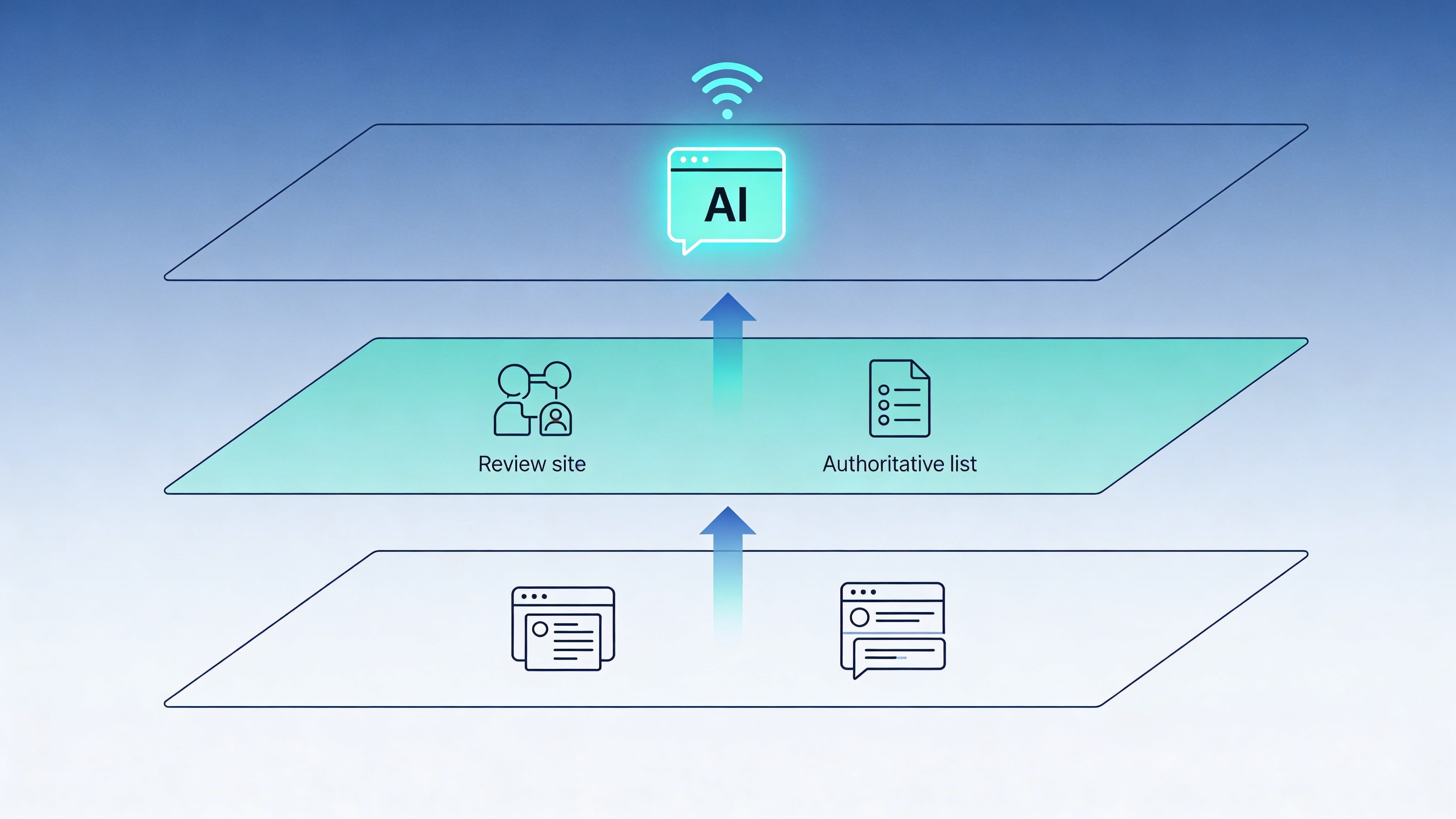
Build authoritative third-party mentions at scale. Authoritative list mentions account for 41% of ChatGPT's brand citation decisions — the single largest factor. This means actively placing your brand in industry roundups, analyst comparisons, expert-authored "best of" lists, and award programs. A single mention in a well-cited industry publication carries dramatically more weight than dozens of self-authored blog posts. Prioritize placements where the host domain is frequently cited in ChatGPT's own responses to category queries — these are the sources the model has already learned to trust.
-
Embed structured entity definitions in your on-site content. ChatGPT builds entity graphs from definitional statements — "X is the practice of Y" or "X refers to Z." Your website should contain explicit, machine-parseable definitions of what your brand does, which category it belongs to, and which problems it solves. Write these in subject-verb-object form in your homepage, About page, and core product pages. Structured data markup (schema.org Organization and Product types) reinforces these definitions for the ~53% of commercial queries where ChatGPT does trigger live web retrieval.
-
Amplify training signals on user-generated platforms. Reddit, Quora, G2, Trustpilot, Capterra, and niche industry forums are heavily represented in ChatGPT's training data. A brand that consistently appears in these conversations — as a recommended tool, a legitimate alternative, a cited resource — accumulates training-corpus weight that static web pages cannot replicate. Encourage customers to write substantive reviews on G2 and Trustpilot. Participate authentically in relevant subreddits and Quora topics. Even one high-upvote Reddit comment in a popular thread comparing tools in your category can become a persistent training signal.
Research by Onely found that 28% of ChatGPT's most-cited pages have zero organic visibility in Google — confirming that the platforms driving AI citations are often different from those driving traditional SEO traffic.
-
Architect content around the exact prompts buyers use. ChatGPT's web search triggers most reliably on commercial-intent queries — roughly 53% of the time, versus 18.7% for purely informational queries. Build dedicated pages and resources that directly answer the comparison and recommendation prompts in your prompt inventory (from Step 1). A page titled "Best [Category] Tools for [Use Case]" that includes your brand alongside credible competitors — structured with clear headers, comparison tables, and explicit category definitions — is far more likely to surface in live retrieval than a generic product page.
Fresh content matters here: 71% of content cited by ChatGPT was published between 2023 and 2025. Publishing or substantially updating core content in 2025–2026 meaningfully raises the probability of citation in live-retrieval queries. For a full framework on structuring content to capture AI visibility, see the AI citation tracking guide that covers how to align content with citation-triggering query patterns across all major platforms.
How to Track and Measure Your ChatGPT Citation Rate Over Time
Measuring your ChatGPT citation rate requires a structured, repeatable testing protocol. Unlike Google Search Console, which surfaces impression and click data automatically, ChatGPT produces no native analytics. You have to build the measurement layer yourself — or automate it.
Use this checklist to establish a reliable measurement cadence:
- Define your core prompt set. Select 15–25 prompts that represent your category's most common buyer queries — at minimum one comparison prompt, one recommendation prompt, and one problem-framing prompt per major use case.
- Run every prompt in a fresh session. Chat history and memory features can skew responses toward brands you've mentioned before. Always test in a new conversation to capture cold-start citations.
- Test on both free and Plus tiers. Free-tier responses lean more heavily on training data; Plus responses trigger more web retrievals. Tracking both gives you visibility into training-data authority versus live-retrieval authority separately.
- Record brand position, not just presence. Whether your brand appears first, second, or third in a ChatGPT answer matters — the model frames early-mentioned brands as primary recommendations and later-mentioned ones as alternatives.
- Run your full prompt set weekly or bi-weekly. ChatGPT's web retrieval component updates continuously; training data refreshes on a longer cycle. Weekly testing catches live-retrieval gains faster; monthly aggregates are more stable for tracking training-data trends.
- Track competitor citation share alongside your own. Your absolute citation rate matters less than your share relative to the 3–4 brands ChatGPT is surfacing. If a competitor's citation rate rises, find out why before your share erodes further.
- Log which sources ChatGPT cites alongside your brand. When the model provides URLs or sources, those are high-value placement targets — put your brand in those same publications.
Running this manually across a 20-prompt set, across free and paid tiers, weekly, is feasible for a single brand. It becomes unmanageable the moment you add multiple product lines, geographic markets, or competitive tracking requirements.
Mentionary automates this entire measurement layer. The platform runs structured prompts across your full buyer-query universe on a continuous basis, tracking citation frequency, competitor share, and trend lines across ChatGPT, Claude, Gemini, and Perplexity. Instead of a weekly manual testing sprint, you get an always-on citation dashboard that surfaces where your brand is gaining ground — and where a competitor just edged you out. The best AI citation monitoring tools comparison for 2026 covers how Mentionary fits alongside other options in the category if you want a broader view before committing.
ChatGPT's citation logic rewards brands that have built genuine authority across third-party sources — not brands that have optimized a single landing page. The seven steps above map directly to the signals that drive that authority: external list mentions, structured entity definitions, user-generated platform presence, and prompt-aligned content architecture. Start with the audit, work through the optimization steps in order, and measure the shift weekly. The brands earning ChatGPT citations in 2026 are not waiting for the algorithm to discover them — they are systematically building the signals the algorithm already knows to trust.
- ChatGPT surfaces only 3–4 brands per response on average, creating winner-take-all visibility dynamics that reward early, deliberate optimization.
- Authoritative list mentions — industry roundups, 'best of' compilations, expert rankings — account for 41% of ChatGPT's brand citation decisions.
- Traditional SEO signals like backlinks and domain authority have near-zero influence on ChatGPT citations; entity recognition and third-party credibility matter far more.
- 71% of content cited by ChatGPT was published between 2023 and 2025, making content freshness a measurable and actionable citation lever.
- Commercial-intent queries trigger ChatGPT's live web search roughly 53% of the time — so optimizing for real-time retrieval is just as important as training-data presence.
- Consistent entity definitions across your website, press coverage, and user-generated platforms accelerate how quickly ChatGPT reliably identifies and recommends your brand.