

AI Competitor Visibility Analysis: How to Track What Rivals Are Getting Cited For in AI Search
Learn the Competitor AI Citation Audit — a repeatable framework for tracking rival brand visibility across ChatGPT, Gemini, Perplexity, and Claude.
Your competitors are appearing in ChatGPT's answers to your buyers' most critical research questions — and right now, you probably have no idea which questions those are.
While your SEO team tracks keyword rankings and your analytics team monitors traffic share, a parallel visibility battle is playing out inside AI-generated answers. Buyers open ChatGPT, Gemini, Perplexity, and Claude to ask which tools to consider, which vendors to trust, and which solutions solve their specific problem. Those AI platforms answer with concrete brand recommendations — and if your rivals are being cited while you are not, you are losing influence at the exact moment a decision is forming.
This guide introduces the Competitor AI Citation Audit — a five-step, repeatable framework for systematically mapping any competitor's AI visibility profile and converting what you find into a clear action plan. If you already understand AI citation tracking for your own brand, competitor AI visibility analysis is the logical next layer: understanding how rivals stack up and exactly where the exploitable gaps are.

What Is Competitor AI Visibility Analysis?
Competitor AI visibility analysis is the practice of systematically tracking which competitors are cited, recommended, or mentioned by AI answer engines — and understanding the context, frequency, and source signals driving those citations — so you can benchmark your brand's position and identify the gaps to close.
Unlike traditional competitive research, this discipline focuses on a brand's presence inside generative AI responses rather than on search engine result pages. The target data is AI-generated answers to buyer-intent prompts, not organic rankings or paid placements. A competitor who barely registers in a Google rank tracker may be the dominant recommended brand in ChatGPT answers — and vice versa.
Why AI Competitor Analysis Differs From Traditional SEO Benchmarking
Traditional SEO competitive intelligence measures keyword rankings, backlink profiles, and estimated organic traffic share. These signals tell you where a competitor ranks on a results page. They tell you nothing about what AI models say when a buyer asks a direct question.
AI citation dynamics operate on completely different inputs. Generative AI models determine which brands to cite based on the breadth and consistency of authoritative signals across the web — third-party review sources, industry publications, forum discussions, expert mentions, and the clarity of a brand's positioning in published content. A brand with a modest domain authority but deep coverage on trusted third-party sites can outperform a high-authority competitor in AI citation frequency.
Share-of-voice tools face the same blind spot. They measure media mention volume and sentiment in news and social content. They do not measure whether an AI model recommends your brand — and they cannot surface the source signals that caused a competitor to be recommended instead of you.
The upshot: competitor AI visibility analysis requires its own methodology. For a grounding in how answer engine optimization differs structurally from traditional SEO, the underlying mechanics are important context — but the competitive intelligence layer requires the audit framework below.
Three Signals Traditional Tools Miss Entirely
- Citation context: AI models don't just mention brands — they frame them. "The leading solution for enterprise teams" is a different citation than "one option to consider." Traditional monitoring captures neither.
- Source attribution: Which third-party sites is the AI drawing on when it recommends a competitor? Reddit threads, G2 reviews, industry blogs? These source signals are invisible to SEO rank trackers.
- Prompt specificity: A competitor might be cited only on narrow, high-intent prompts — or broadly across category queries. The distribution pattern reveals strategic opportunities that aggregate mention counts obscure.
The Competitor AI Citation Audit: A Step-by-Step Framework
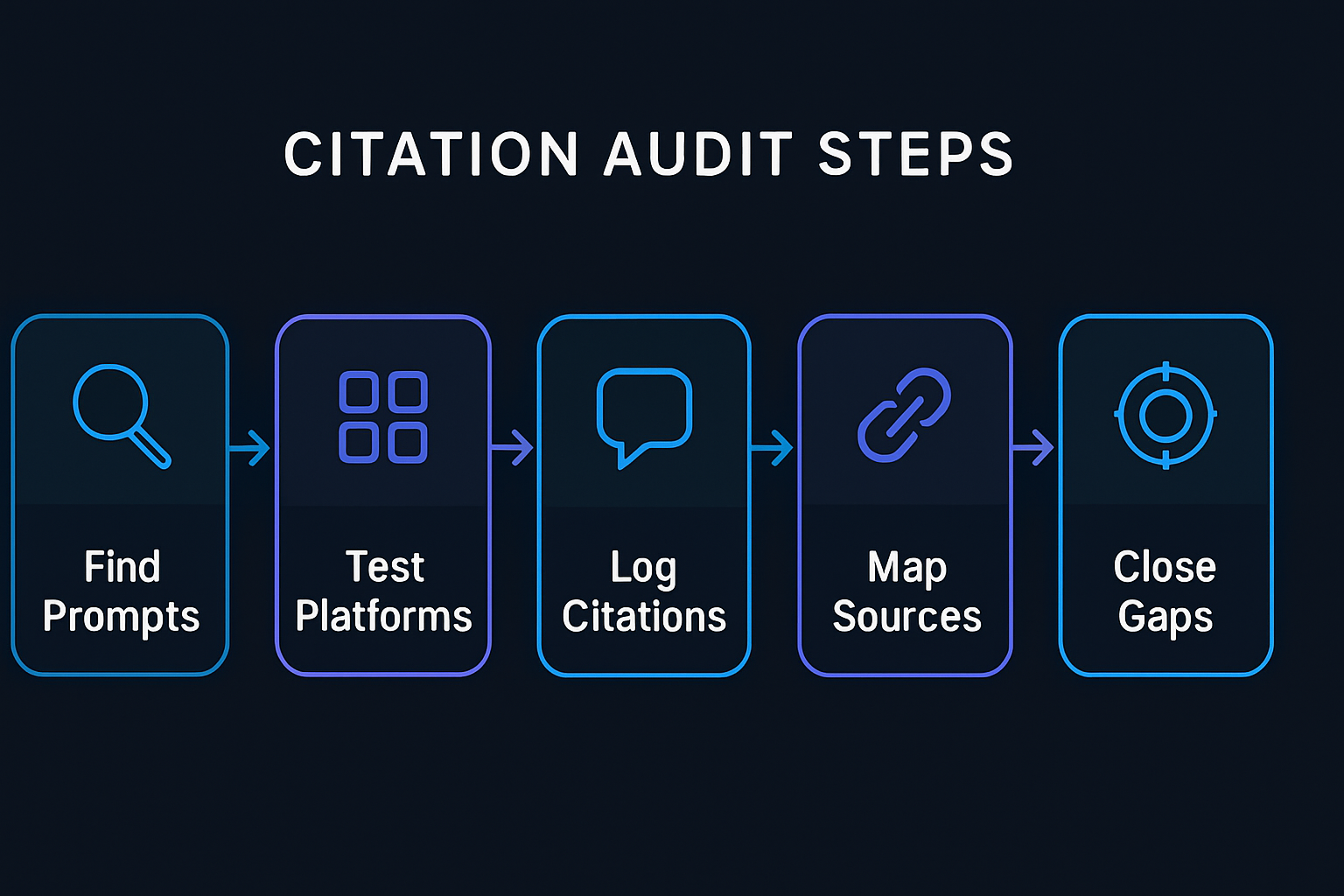
The Competitor AI Citation Audit is a structured, repeatable approach to building a complete picture of any rival's AI visibility. Run it manually to start; automate it as your competitive intelligence program matures.
-
Identify buyer-intent prompts in your category. Start with the questions your buyers actually ask during research and evaluation — not broad category queries, but specific decision-stage prompts. Examples: "What is the best tool for [use case] for a [company size] team?" or "Which platforms do marketing teams use for [specific outcome]?" Aim for 15–25 prompts that span awareness, evaluation, and purchase stages. These are the prompts you will test across every platform.
-
Run every prompt across ChatGPT, Gemini, Perplexity, and Claude. Test each prompt in a clean, logged-out session with no prior context. Record the full AI response verbatim — don't paraphrase. Run each prompt two to three times across different sessions, since generative AI responses vary. Note which competitors are named, in what order, and with what framing. Consistency across runs signals strong citation pull; inconsistency signals a weaker or contested position.
-
Log citation frequency, position, and context. For each competitor cited, record: how often they appear across your prompt set; whether they appear first, mid-list, or as an afterthought; and the exact framing — are they the recommended solution, a feature comparison point, or a cautionary example? This citation context is the most underanalyzed dimension of competitor AI visibility analysis. A brand cited first with a trust-signal sentence ("widely regarded as…", "most commonly recommended for…") is in a categorically stronger position than one listed at the bottom of a generic comparison.
-
Map the source signals behind competitor citations. On Perplexity especially, AI responses surface explicit source links — examine which third-party URLs are cited alongside your competitors. On ChatGPT and Gemini, analyze the language patterns in responses for clues: phrases like "according to user reviews," "frequently mentioned in industry discussions," and "recognized by [publication type]" point to the underlying source types the model is drawing on. Build a source signal map for each top-cited competitor: which external properties are giving them citation authority you currently lack?
-
Identify your highest-value citation gaps. Cross-reference your brand's citation profile against each competitor's. The highest-priority gaps are prompts where a competitor is consistently cited and you are entirely absent — particularly at evaluation and purchase stages. Secondary gaps are prompts where you are cited but with weaker framing, lower position, or narrower source backing than the leading competitor. Document both: they map directly to content and authority-building priorities.
Competitor AI Visibility Benchmarks by Platform
What strong versus weak competitor AI visibility looks like varies by platform. Use this reference table when evaluating your audit findings to calibrate what you are actually seeing.
| Platform | Primary Citation Signal | Strong Competitor Visibility | Weak Competitor Visibility |
|---|---|---|---|
| ChatGPT | Broad web training + user consensus signals | Named first by brand across multiple prompt phrasings; trust-framing language ("widely used," "most recognized") | Absent or named only in generic lists; no framing language; inconsistent across repeated tests |
| Gemini | Google ecosystem authority + structured web content | Cited consistently on evaluation prompts; strong presence on Google-indexed review and comparison pages | Mentioned only on broad category queries; weak presence on third-party structured sources |
| Perplexity | Real-time source retrieval + citation links | Named with explicit source citations from high-authority third-party sites; sourced from review platforms and industry publications | Absent from cited sources; appears in answer text only without attribution links |
| Claude | Training data authority + content clarity | Named in expert and evaluative contexts; cited on prompts requiring nuanced recommendation | Not mentioned; or mentioned only in comparison lists without evaluative weight |
Turning Competitor Gaps Into Your Content and Authority Strategy
A completed Competitor AI Citation Audit is only valuable if it drives action. Use your gap map as the direct input to your content and authority-building roadmap. The checklist below translates audit findings into executable priorities.
- Close prompt-level content gaps first. For every high-intent prompt where a competitor is cited and you are absent, create or update content that directly addresses that exact question — with clear, entity-rich prose that AI models can extract and cite.
- Target the third-party sources driving competitor citations. If your source signal map shows a rival being sourced from G2, a specific industry blog, or a Reddit community, those are the external properties where you need stronger presence — through reviews, contributed content, or community engagement.
- Audit your framing language on owned properties. Competitors cited with strong trust signals often use consistent, quotable positioning statements across their site and external content. Identify the framing that matches your strongest buyer-intent prompts and make it prominent and consistent.
- Build comparison coverage deliberately. AI models frequently cite brands in evaluative comparisons. If competitors consistently appear in "[Your category] vs. [Competitor]" AI answers and you do not, publish your own authoritative comparison content targeting those exact head-to-head scenarios.
- Prioritize evaluation-stage and purchase-stage prompts over awareness prompts. Citation gaps at the top of the funnel are lower urgency. Gaps at the stage where a buyer is actively choosing are where lost AI visibility most directly translates to lost revenue.
- Re-run the audit after 4–6 weeks to measure movement. AI citation profiles shift as model retrieval updates and as third-party content accumulates. Track changes in a shared log so your team can see which content and authority investments are generating citation gains.
How to Automate Competitor AI Visibility Tracking With Mentionary
The manual audit framework described above is a powerful starting point — but running it manually across four AI platforms, dozens of prompts, and multiple competitors every month is operationally intensive. The tracking spreadsheets grow unwieldy, prompt variation introduces inconsistency, and the cadence required to catch meaningful shifts rarely survives competing team priorities.
Mentionary's Competitor Visibility Analysis feature is built to replace that manual workflow. You configure the competitors you want to track and the buyer-intent prompt categories relevant to your market, and the platform continuously monitors named competitors across ChatGPT, Gemini, Perplexity, and Claude. It surfaces citation frequency, citation context, and the source signals driving competitor recommendations — updated automatically so your team always has a current view of the competitive landscape without running manual sessions.
Where the manual audit gives you a periodic snapshot, Mentionary gives you a continuous signal. Emerging competitor citation gains show up before they compound. Gaps you closed — through new content, third-party coverage, or positioning updates — register as measurable visibility improvements. For a broader view of the AI citation monitoring tools available in 2026, the competitive intelligence use case is one of the most differentiated and least served by general-purpose SEO platforms.
The Competitor AI Citation Audit gives you the framework. Mentionary gives you the infrastructure to run it at scale, continuously, without the manual overhead.
- Competitor AI visibility analysis tracks which rivals are cited in AI answers — and reveals why AI models recommend them over you.
- Traditional rank trackers and share-of-voice tools are blind to AI citation dynamics — a separate competitive intelligence model is required.
- The Competitor AI Citation Audit is a five-step repeatable framework: identify buyer-intent prompts, test across platforms, log citation frequency and context, map source signals, then close gaps.
- Citation context matters as much as frequency — a competitor named as 'the leading solution' outperforms one merely listed in a comparison.
- The highest-priority gaps are prompts where a competitor is consistently cited at the evaluation or purchase stage and your brand is absent.