
How to Get Your Brand Cited in Claude AI: A Step-by-Step Optimization Guide
Learn how to get cited in Claude AI: Claude's citation mechanics, the 6 key visibility factors, and a step-by-step content optimization strategy for 2026.
ChatGPT and Perplexity get most of the AEO attention — but Claude now handles millions of business and professional queries every day, and almost no brand has a Claude-specific visibility strategy. That gap is a competitive advantage waiting to be claimed.
This guide gives you a complete, platform-specific playbook for how to get cited in Claude AI: the mechanics behind Claude's citation decisions, a six-factor optimization checklist, and a step-by-step action plan you can start executing this week. If you are still building your general AEO foundation, our comprehensive Answer Engine Optimization guide covering ChatGPT, Claude, Gemini, and Perplexity is the right starting point before going platform-specific.
What Is Claude Citation Optimization — and Why It Requires Its Own Strategy
Claude citation optimization is the practice of structuring your brand's content, entity signals, and third-party authority so that Claude's language models select your brand as a relevant, trustworthy reference when answering buyer queries in your product category. It differs from general AEO because Claude's training data preferences, Constitutional AI guidelines, and source authority weighting differ materially from those of ChatGPT or Perplexity.
Every major AI answer engine has a distinct retrieval architecture, and treating them as interchangeable is one of the most common mistakes in AEO strategy. Research from the 5W AI Platform Citation Source Index 2026 confirms that only 11% of sites cited by one major AI platform appear as top citations on another. What earns you a mention in ChatGPT may do nothing for your Claude visibility.
Claude is particularly important for B2B and professional service brands. Anthropic's models are widely used in enterprise workflows, developer tools, and research contexts — exactly the high-intent decision-making environments where a brand citation translates into pipeline. A Claude-specific strategy is not optional for companies competing in these segments.
How Claude Decides Which Brands and Sources to Mention
Claude selects brands and sources based on a combination of training data authority, entity recognition, Constitutional AI alignment, and — in web-search-enabled deployments — real-time source quality. Understanding each layer gives you a roadmap for where to focus your optimization effort.
Training Dataand Entity Authority
For most Claude interactions, the model draws on its training data rather than live web browsing. According to Anthropic's official model documentation, Claude Opus 4.7 — the current flagship — has a reliable knowledge cutoff of January 2026. Claude Sonnet 4.6 has a cutoff of August 2025, and Claude Haiku 4.5 cuts off at February 2025.
This means the content, coverage, and third-party mentions published before those dates directly shape whether your brand exists as a recognized entity in Claude's model. Brands with limited pre-cutoff footprints are essentially invisible to training-based citation.
Claude's source preferences lean heavily toward premium editorial content. Data from the 5W AI Platform Citation Source Index 2026 shows Claude disproportionately cites publications including The New York Times, The Atlantic, The New Yorker, and The Economist. Only 36% of Claude's journalism citations come from the past 12 months, compared to 56% for ChatGPT — Claude places higher weight on established archival authority than on recency alone.
Constitutional AI and Helpfulness Framing
Anthropic trains Claude using a Constitutional AI framework, which means Claude applies an internal set of principles around accuracy, helpfulness, and avoiding harm when formulating answers. In practice, this makes Claude more cautious about citing brands in promotional contexts and more likely to cite a brand when doing so directly serves the user's informational need.
Brands that frame their content around solving a clear problem — rather than selling a product — align better with this helpfulness filter. Content that answers questions, defines concepts, and provides evidence-backed guidance performs better than content structured as marketing copy.
Claude's Web Search Capability
Claude's citation behavior is not limited to training data. Anthropic launched web search on the Claude API in May 2025, enabling real-time retrieval and citation of current web content. An update in September 2025 added a web fetch tool for retrieving content from specific URLs. As of 2026, the improved web_search_20260209 tool version is available on the Anthropic API and Microsoft Azure, with dynamic filtering that refines search results before they enter the model's context window.
For brands targeting API-powered products — customer-facing tools, internal knowledge bases, enterprise search — optimized, crawlable content can surface in Claude's cited answers within days of publication. The API web search feature is opt-in and costs $10 per 1,000 searches, so not every Claude deployment uses it. But its availability means your optimization strategy needs to serve both the training-data pathway and the real-time retrieval pathway simultaneously.
The 6 Factors That Drive Claude AI Citation Frequency
Claude citation frequency is determined by six measurable, improvable factors. Use this checklist as a self-audit: score your brand against each one to identify your highest-leverage gaps before building your action plan.
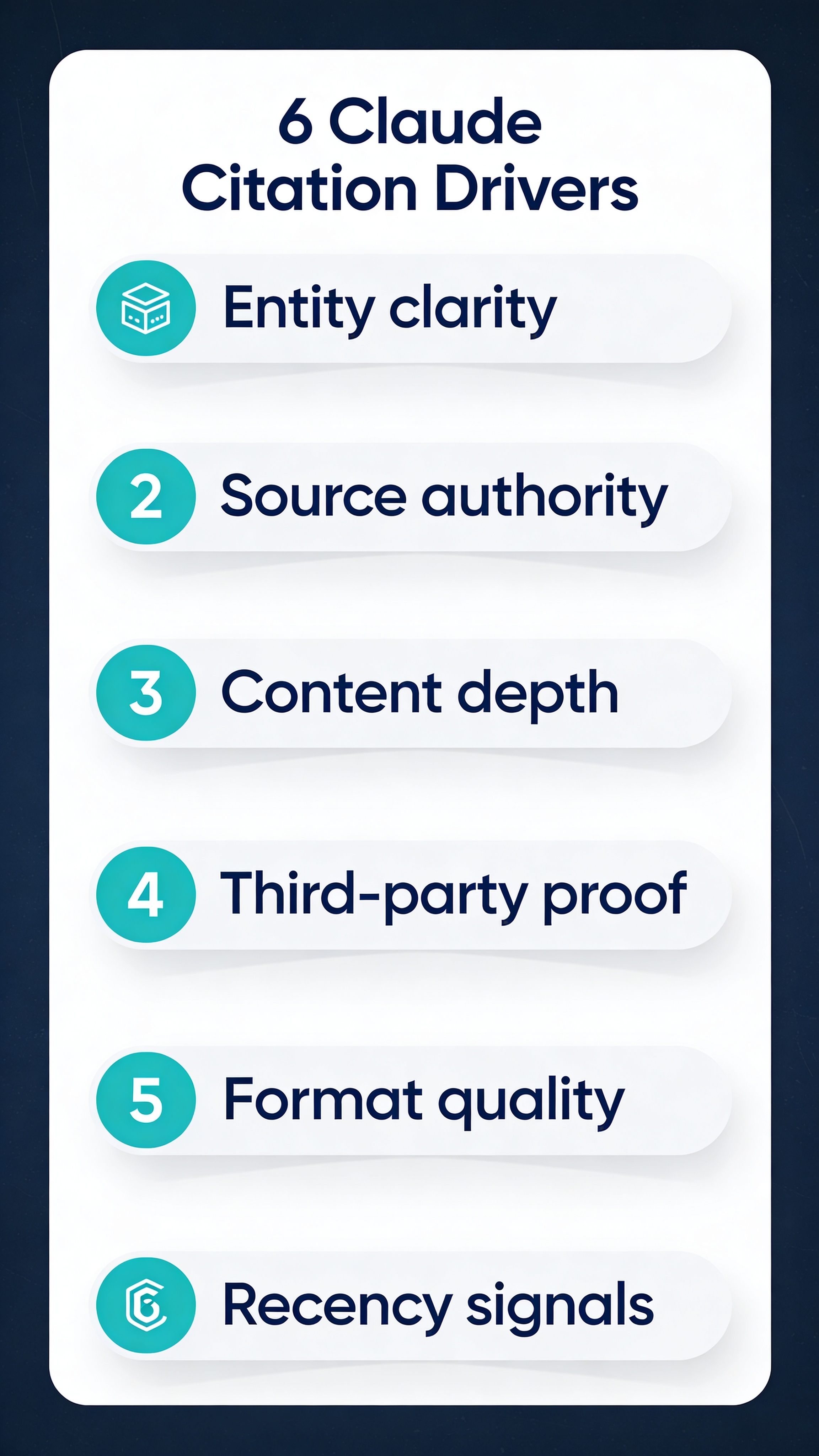
- Entity clarity. Claude must be able to recognize your brand as a distinct, well-defined entity with an unambiguous category, use case, and differentiator. Brands with muddled or overlapping positioning are frequently skipped in favor of clearer alternatives.
- Source authority. Your content needs to appear on or be cited by sources Claude already trusts — premium publications, authoritative industry sites, and high-credibility reference pages. Presence on low-authority or thin sites contributes little citation signal.
- Content depth. Claude favors long-form, evidence-backed content that demonstrates substantive expertise. Thin pages, marketing landing pages, and content without supporting detail are weak citation candidates relative to comprehensive guides or research pieces.
- Third-party proof. Brand mentions in independent sources — Reddit discussions, Trustpilot reviews, industry analyst reports, editorial coverage — function as corroborating signals that Claude uses to validate a brand's authority before recommending it.
- Format and structure quality. Well-structured HTML with clear headings, entity definitions, and semantic markup makes it easier for Claude's training pipeline and real-time retrieval to extract and attribute your content accurately.
- Recency signals. While Claude leans toward archival authority, newly published content can still influence citation frequency — especially in web-search-enabled deployments and ahead of upcoming model training cutoffs. Consistent publishing cadence matters more than intermittent volume.
Step-by-Step: How to Get Your Brand Cited in Claude AI
Getting cited in Claude AI requires executing across entity definition, content structure, authority sourcing, and ongoing measurement in sequence. The following steps build on each other — start at step one, even if you believe your content is already strong.
-
Define and consolidate your brand entity. Write a single, precise brand definition that answers: what does your brand do, for whom, and what is the primary outcome it delivers? This definition should appear verbatim — or near-verbatim — on your homepage, your About page, your LinkedIn page, and your Wikipedia article if one exists. Claude's entity recognition is pattern-matching across sources; consistency across those anchor points signals a clearly defined, trustworthy entity.
-
Audit your content against Claude's source preferences. Review your highest-traffic pages and ask: does this content read like something The Atlantic or The Economist would publish, or does it read like a product landing page? Claude's citation filter applies a quality heuristic that correlates with premium editorial standards. Pages that define concepts clearly, provide supporting evidence, and anticipate user questions perform measurably better than pages that lead with features and pricing.
-
Build or commission third-party coverage on trusted sources. Claude treats corroborating third-party mentions as a trust multiplier. Prioritize getting your brand into the specific source types Claude already cites heavily: industry news publications, analyst roundups, editorial review sites, and substantive Reddit discussions in your product category. A single well-placed mention on a high-authority source can carry more citation weight than dozens of low-authority links.
For a deeper breakdown of which citation sources carry the most weight across AI platforms, see our guide to AI citation tracking across ChatGPT, Claude, Gemini, and Perplexity.
-
Restructure your key pages for semantic clarity. Claude extracts meaning more reliably from HTML that uses descriptive headings, defined terms, and structured lists. For every key solution page, add an explicit definition block — "X is a [category] that [primary benefit] for [target user]" — in the first paragraph. Use
<h2>and<h3>headings that are question-shaped or definitional, since these directlymirror the query types Claude is answering when it cites sources. -
Publish before the next model training cutoff. Because Claude's base models operate on training data, content published and indexed before the next cutoff date will have the opportunity to be incorporated into upcoming model releases. Based on current release cadence, publishing authoritative content today and building third-party coverage over the next several months positions your brand for inclusion ahead of the next training cycle. Do not wait for the "right time" — the cutoff window is always closing.
-
Optimize for the web-search pathway separately. For API-powered Claude deployments that use real-time search, standard technical SEO practices apply — fast load times, clean semantic markup, accessible content, and strong page-level topic focus. Ensure your most authoritative solution pages are crawlable, indexed, and load quickly. A page that ranks well and loads reliably is a more attractive real-time citation target than a technically weak page regardless of its content quality.
Claude vs. ChatGPT vs. Perplexity: Citation Behavior Compared
Each major AI answer engine has a distinct citation architecture, and optimizing for one platform does not automatically carry over to the others. The table below maps the key differences to help you prioritize effort by platform.
If you are also building a ChatGPT visibility strategy, our ChatGPT brand monitoring guide covers platform-specific tactics in the same depth as this guide. For Perplexity, see our Perplexity brand mention monitoring guide.
| Dimension | Claude | ChatGPT | Perplexity |
|---|---|---|---|
| Knowledge cutoff | Jan 2026 (Opus 4.7); Aug 2025 (Sonnet 4.6) | Varies by model; web browsing enabled by default in ChatGPT UI | Always real-time; search-first architecture |
| Real-time web access | Opt-in via API (launched May 2025); not always active in consumer UI | Enabled by default in ChatGPT consumer product | Core functionality; every query retrieves live web results |
| Citation style | Inline citations to authoritative sources; prefers editorial and technical precision | Numbered footnotes to open-access sources; Wikipedia-heavy (26–48% of top-10 share) | Source cards with direct URLs; Reddit comprises 46.7% of top-10 citations |
| Top source preferences | NYT, The Atlantic, The Economist, The New Yorker (5W Citation Index 2026) | Wikipedia, Reddit, Forbes, Business Insider | Reddit, YouTube, NIH/PubMed, named B2B authorities |
| Recency bias | Low — only 36% of journalism citations from past 12 months | Moderate — 56% of journalism citations from past 12 months | High — optimized content can appear in citations within hours |
| Dominant use context | B2B research, professional writing, enterprise workflows, coding | General consumer, broad research, productivity | Real-time research, factual lookups, product comparisons |
| Best content type for citation | Authoritative long-form guides, editorial coverage, clear entity definitions | Wikipedia presence, Reddit discussions, mainstream editorial | Primary sources, review site presence, community discussions |
The platform-level divergence is significant. Analysis by Discovered Labs found that only 12% of AI-cited sources overlap with Google's top 10 results — an "Invisibility Gap" where strong traditional SEO does not guarantee any AI platform visibility. Each platform requires a tailored strategy, not a port of your existing SEO work.
How to Track Your Claude Citation Rate and Measure Progress with Mentionary
An optimization strategy without measurement is a guess. The only way to know whether the steps above are moving your Claude citation frequency is to systematically test prompts before and after each change, track mention frequency over time, and compare your performance against competitors in the same category.
Manual prompt testing works at small scale — run 20-30 representative queries about your product category in Claude, record whether your brand appears, note the context, and repeat monthly. The friction compounds quickly as your query set grows, and competitive benchmarking requires running the same queries against multiple AI platforms simultaneously.
Mentionary automates this feedback loop for Claude and the other major AI answer engines. The platform monitors brand citation frequency and context across real Claude queries, runs competitor visibility analysis to show how rivals rank in Claude-generated answers, and tracks which third-party sources — Reddit threads, Trustpilot reviews, editorial mentions — are driving citation appearances. This gives marketing and SEO teams the before/after data needed to validate whether the content, authority, and entity optimizations in this guide are actually moving the needle.
The combination of systematic optimization (the steps in section 4) plus consistent measurement (a Claude citation tracking dashboard) is what separates brands that grow their AI visibility from those that publish content and hope for the best. Citation rate is a measurable, improvable metric — treat it like one.
- Claude's citation engine favors premium editorial sources like The New York Times and The Atlantic — authoritative long-form content is a higher-leverage investment than social media presence alone.
- The flagship Claude Opus 4.7 has a knowledge cutoff of January 2026, so recently published content can already influence its answers. Recency matters more than most brands realize.
- Claude supports real-time web search via its API (launched May 2025), meaning optimized content can surface in cited answers on a much shorter timeline for API-powered deployments.
- Only 12% of AI-cited sources overlap with Google's top 10 results — strong traditional SEO does not guarantee Claude citation visibility. A platform-specific strategy is essential.
- Third-party proof on sources Claude already trusts — Reddit discussions, Trustpilot reviews, industry blog mentions — is often a faster citation lever than publishing new first-party content.
- Systematic prompt testing and monthly citation rate tracking is the only way to know whether your optimization efforts are actually moving Claude's recommendation frequency.