
AI Citation Sources: How ChatGPT, Perplexity, and Gemini Choose What to Cite — and How to Get Your Brand Included
Discover which external sources ChatGPT, Perplexity, and Gemini trust for answers — and how to audit and close your brand's AI citation source gaps.
Every time ChatGPT recommends a product or Perplexity answers a buying question, it's pulling from a specific layer of the web — one most brands have never thought to audit, and that no amount of on-site SEO can fix on its own.
That layer is made up of AI citation sources: the third-party websites, forums, review platforms, and publications that AI engines retrieve and reference when forming answers. Understanding which sources each engine trusts — and whether your brand appears across them — is the difference between being recommended and being invisible.
If you already have AI citation tracking in place to monitor brand mentions across AI engines, this guide goes one layer deeper: the source layer itself. You'll learn exactly which external source categories each major AI engine draws from, how to audit your brand's current footprint across those sources, and what to do when you find gaps.

What Are AI Citation Sources?
AI citation sources are the external websites and platforms that AI answer engines retrieve and reference when constructing responses. Rather than relying solely on training data, engines like Perplexity, ChatGPT (with browsing enabled), and Gemini pull from specific categories of third-party content — forums, review sites, news outlets, industry publications, and structured data aggregators — to ground their answers in current, credible information. These sources, not your own website, are the primary signals that determine whether your brand gets recommended.
This is the distinction most marketers miss. AI engines are not simply "reading" your website. They are aggregating signals from dozens of external sources, then synthesising those signals into a recommendation. If your brand is absent from the source categories these engines trust, on-site optimisation alone will not make you appear in AI-generated answers.
This is why AI search citation source tracking has become a foundational practice in modern brand visibility strategy — you cannot close a gap you haven't identified.
How ChatGPT, Perplexity, Gemini, and Claude Each Select Their Sources
Each AI engine uses a different combination of retrieval architecture, training data, and real-time web access to select its sources. The table below maps each engine to its primary source categories, giving you an at-a-glance reference for where to focus your efforts per engine.
| AI Engine | Forums & Reddit | Review Platforms | News & Press | Industry Publications | Brand-Owned Content |
|---|---|---|---|---|---|
| ChatGPT (browsing) | High | High | High | Medium | High |
| Perplexity | High | High | Very High | High | Medium |
| Gemini | Medium | Medium | Very High | Medium | High |
| Claude | Medium | Medium | High | High | High |
Perplexity is the most retrieval-heavy of the major engines, typically citing multiple sources per answer with a strong lean toward news and authoritative publications. For a closer look at how Perplexity surfaces brand content and which signals drive its recommendations, see the guide on monitoring brand mentions in Perplexity AI.
Gemini's deep integration with Google's index makes news coverage and long-form authoritative content especially impactful for brands targeting that engine. ChatGPT's browsing mode behaves similarly to Perplexity but applies a stronger pull toward commercial review platforms when answering product comparison or "best tool for X" queries.
The Six Source Categories AI Engines Trust Most
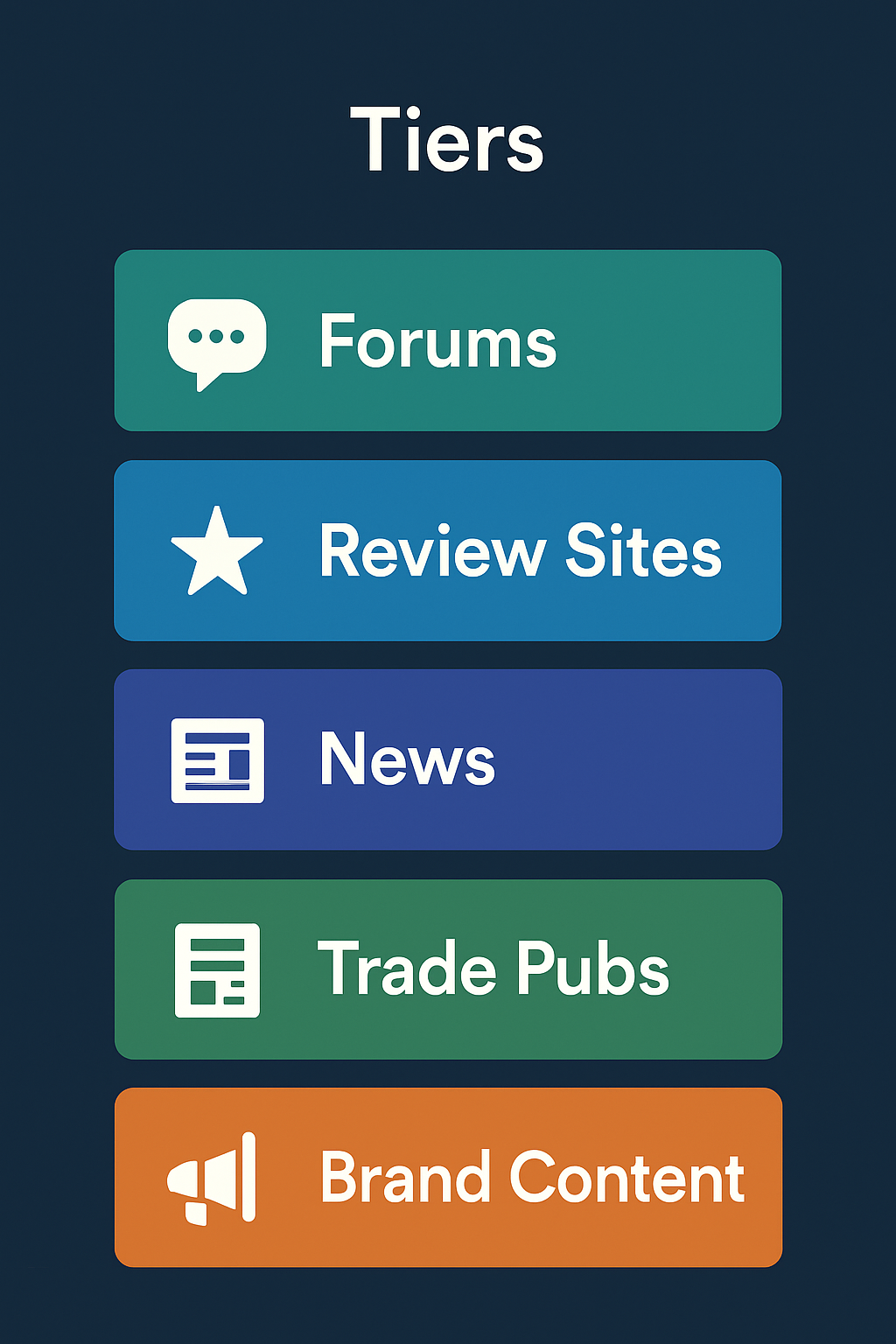
Across all major AI engines, six source categories appear consistently in answers. Building a meaningful presence across each category — not just one or two — is what separates brands that get cited from brands that don't. This multi-source approach is central to any effective Answer Engine Optimization strategy.
1. Forums and Community Platforms
Reddit is the single most frequently cited forum source across all major AI engines. Its combination of authentic peer-to-peer discussion, high domain authority, and topical breadth makes it the default reference point for "what do real users think?" queries. Specific subreddits function as trusted vertical communities that AI engines treat as representative user sentiment for their niche.
2. Professional Review Platforms
For B2B brands, G2, Trustpilot, Capterra, and Gartner Peer Insights are among the review platforms AI engines weight most heavily. These platforms provide structured, aggregated user sentiment that AI engines can parse efficiently. Consumer-facing categories draw from Amazon reviews, Yelp, and Tripadvisor depending on the query type. Volume and recency of reviews on these platforms are the two variables that matter most.
3. Mainstream News and Press Coverage
News outlets with high editorial standards — national newspapers, major business publications, and wire services — carry significant weight because AI engines treat editorial gatekeeping as a credibility proxy. A brand mentioned in a mainstream press article consistently delivers a stronger citation signal than the same brand mentioned on its own blog.
4. Industry Trade Publications and Vertical Media
Niche publications covering specific verticals — marketing, fintech, healthtech, legal — are trusted sources for industry-specific queries. Getting featured in a respected trade publication often delivers more AI citation impact than broad press coverage, because the specificity of the source matches the specificity of the buyer query.
5. Structured Data Aggregators and Directories
Sources that present information in structured, machine-readable formats — industry directories, comparison sites, regulatory databases, and government portals — are consistently cited when AI engines need factual grounding. Claiming and fully completing your listings on relevant aggregators improves the likelihood these structured signals are retrieved for specification-heavy queries.
6. Brand-Owned Content (Used Selectively)
Official websites, documentation, and brand-published content are cited, but weighted lower than independent sources for comparative or recommendation queries. AI engines tend to use brand-owned content for factual specifications, pricing, and feature details — but defer to independent sources for opinion-based and "which is best?" queries.
How to Audit Your Brand's AI Citation Source Footprint
An AI citation source audit maps which source categories currently mention your brand, cross-references them against each engine's source preferences, and surfaces the specific gaps preventing citations. Run this process quarterly at minimum — source selection shifts as models update and retrieval indices refresh.
- Define the query scenarios relevant to your brand. Start with the buyer questions your customers actually type into AI engines — product comparisons, "best [category] for [use case]" queries, and problem-solution prompts. These define the answer set where your brand should appear.
- Run those queries in each major AI engine. Submit the queries in ChatGPT (with browsing enabled), Perplexity, and Gemini. Record every source cited in the answer — not just whether your brand appears, but which external URLs the engine referenced to form its response.
- Categorise the cited sources by type. For each source set, label by category: forum thread, review platform, news article, trade publication, directory, or brand-owned. This reveals the engine's actual source preferences for your specific topic area — which often differs from the general defaults in the table above.
- Map your brand's current presence in each cited category. For every category the engine cited, check whether your brand has a meaningful presence. Is your brand reviewed on the cited platform? Is it discussed in the cited subreddit? Has it been covered by the cited publication type?
- Score each gap by engine weight and effort to close. Not all gaps are equal. A missing G2 profile (high engine weight, low effort to fix) is a more urgent priority than a missing trade press mention (high weight, higher effort). Rank gaps by the ratio of citation impact to time investment.
- Set a baseline and retest monthly. A one-time audit decays quickly as models update and new content enters retrieval pools. Establish a monthly cadence to re-run your core query set and check whether new sources have entered the engine's reference pool for your category.
Priority Actions to Improve Your Presence Across AI Citation Sources
Once you've mapped your gaps, the following checklist delivers the highest citation impact relative to effort. Work through it in order — items at the top close the fastest-moving gaps first.
- Claim and fully complete your profiles on G2, Trustpilot, and Capterra. Incomplete or unclaimed profiles are treated as low-authority signals. A complete profile with a substantial, recent review count dramatically increases the likelihood of citation.
- Run an active review generation campaign targeting the platforms AI engines cite most. Recency is a ranking signal for retrieval-based engines. A focused push to generate fresh reviews on key platforms is one of the fastest levers available.
- Identify the subreddits where your buyers research decisions and contribute genuinely helpful answers. Reddit citations favour threads with high upvotes and engagement. Authentic participation over time — not promotional posts — is what builds the durable presence AI engines reference.
- Build a trade press target list and pitch for inclusion in roundup and comparison articles. "Best [category] tools" articles in respected industry publications are citation gold — they are precisely the format AI engines retrieve for comparison queries.
- Ensure your brand appears in relevant structured directories and comparison sites for your category. These aggregators are frequently cited for specification-heavy and feature-comparison queries where structured data outperforms prose.
- Optimise brand-owned pages for the factual queries AI engines use them for — pricing pages, feature comparison pages, integration documentation, and use-case pages. Use clear heading structure and schema markup so AI engines can parse your content efficiently.
- Monitor which new sources AI engines start citing for your query set each month and add them to your active presence strategy. The source landscape is not static; your presence must evolve with it.
Using Citation Source Tracking to Find and Close Your Gaps Automatically
The manual audit described above is powerful — but time-consuming to run consistently across multiple query scenarios and multiple AI engines. At scale, most marketing teams need a way to automate source discovery and gap detection without running hundreds of manual queries each month.
This is the problem Mentionary's Citation Source Tracking feature is built to solve. Rather than requiring manual query submission, Mentionary simulates buyer conversations with each major AI engine — ChatGPT, Perplexity, Gemini, and Claude — and captures the exact external sources each engine references when forming answers about your brand and your category.
The output is a structured map of the source layer: which specific Reddit threads, review platform pages, news articles, and industry publication entries are being retrieved when AI engines answer questions relevant to your brand. Sources that are absent — categories where your competitors are cited but you are not — are flagged as gaps with prioritised recommendations for closing them.
Instead of a monthly point-in-time snapshot, Citation Source Tracking runs continuously. It alerts you when a new source enters the engine's reference pool, when a negative source gains traction, or when a gap has been closed by a new review or press placement. That continuous visibility turns source tracking from a diagnostic exercise into an active acquisition channel — one that compounds over time as each gap you close strengthens the next citation cycle.
For teams already investing in brand monitoring, Citation Source Tracking answers the question those tools leave open: not just whether your brand appears in AI answers, but which source signals are driving or blocking it — and exactly where to act next.
- AI citation sources are the third-party websites — forums, review platforms, news outlets, industry publications — that AI engines retrieve and reference when forming answers. They are distinct from a brand's own website.
- Each major AI engine weights source categories differently: Perplexity leans heavily on news and real-time web retrieval; Gemini prioritises Google-indexed news and authoritative content; ChatGPT's browsing mode weights review platforms and forums highly.
- Reddit, professional review platforms (G2, Trustpilot, Capterra), and mainstream press coverage are the three source categories with the widest impact across all major AI engines.
- Traditional SEO rank does not predict AI citation. A brand can hold page-one Google rankings while being entirely absent from AI-generated answers if its third-party source footprint is thin.
- Closing citation source gaps — completing review profiles, participating in relevant forums, earning trade press placements — is the highest-leverage lever for improving AI recommendation rates.