
AI Citation Source Analysis: How to Find Out Which Websites Drive AI Citations in Your Category
Find out which third-party websites drive your AI citations in ChatGPT, Gemini, and Perplexity using the AI citation source analysis methodology.
Your brand got cited in Perplexity last week — but the source Perplexity actually pulled from probably wasn't your website. It was a Reddit thread, a G2 review page, or a trade blog you've never heard of. AI citation source analysis is the practice of finding out exactly which third-party sites are driving — or suppressing — your AI visibility, and building a strategy around them.
The gap between "am I cited?" and "what's making me cited?" is where most brands stall. Understanding how AI citation tracking works at a fundamental level is the starting point, but knowing which external platforms carry the most citation influence in your category is where the strategic leverage lives. This guide walks through a structured methodology for identifying those sources, auditing your competitors' footprint, and building a presence on the platforms that actually move the needle.

What Is AI Citation Source Analysis?
AI citation source analysis is the systematic practice of identifying which specific third-party websites — review platforms, community forums, trade publications, and user-generated content — are responsible for the citations AI engines produce about a brand or category. It moves beyond tracking whether a brand is cited to mapping the external source infrastructure that determines citation probability — and which platforms your brand should prioritize to improve it.
The distinction matters because AI engines rarely build answers exclusively from a brand's own website. An analysis of 233 ChatGPT software recommendations across 40 B2B SaaS categories found that the vendor's own site accounted for just 11.6% of citation sources. The remaining 88% came from third-party content — independent blogs, trade publications, community discussions, and review platforms. That means the majority of your AI visibility is shaped by sites you don't own, but can still influence.
Citation source analysis for answer engines is also distinct from traditional backlink analysis. Backlink audits measure link equity flowing to your domain. Citation source analysis identifies the platforms AI engines actively pull content from when generating answers — a different signal set driven by editorial credibility, topical authority, and recency rather than PageRank.
The Five Source Types AI Engines Cite Most
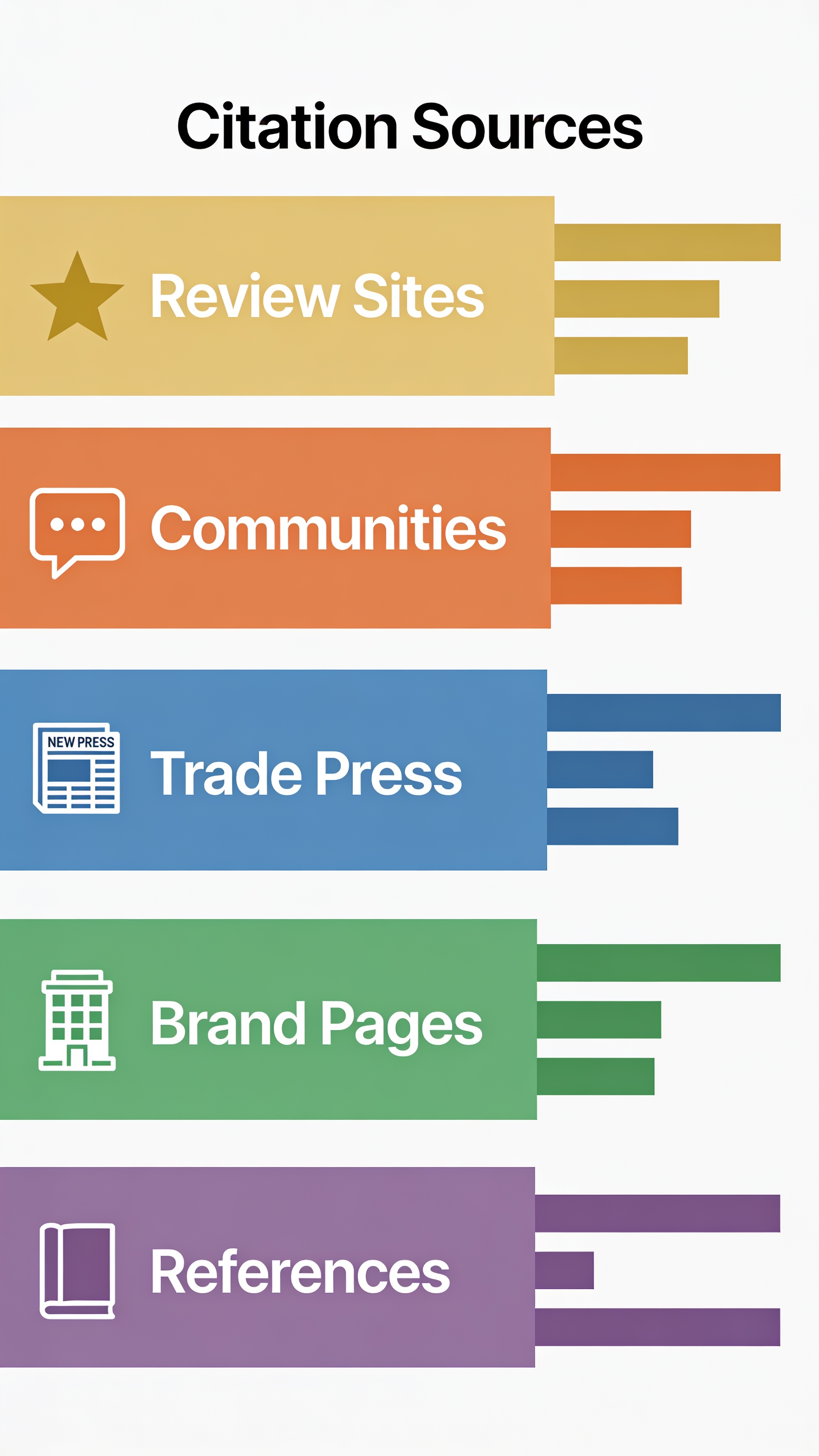
Not all third-party sources carry equal weight with AI engines — and the distribution varies significantly by engine, query type, and whether the engine uses real-time retrieval or a fixed training corpus. The following taxonomy maps the five primary source categories to their observed citation frequency across ChatGPT, Gemini, and Perplexity, giving you a prioritized starting point for AI search citation sources research in your category.
| Source Type | Citation Frequency & Key Platforms |
|---|---|
| Review Platforms | Engine-dependent and often counterintuitive. Promptwatch's analysis of 100M+ citations places Trustpilot as the 5th most-cited domain globally on ChatGPT; G2 and Capterra appear more frequently in Google AI Overviews than in standalone ChatGPT or Perplexity responses. For B2B SaaS queries, review aggregators collectively account for under 1% of ChatGPT citations. Examples: G2, Trustpilot, Capterra, Clutch. |
| Q&A Communities | High influence, high volatility. Reddit alone accounts for approximately 24% of Perplexity citations and 11% of ChatGPT citations — the single highest-influence community source across both engines. Citation share can collapse rapidly following platform policy changes. Examples: Reddit (dominant), Quora. |
| Trade Publications | Consistent and durable. Journalistic and editorial content accounts for roughly 27% of all AI citations across engines, rising to 49% for time-sensitive or news-adjacent queries. Independent software review blogs and industry newsletters sit in this category alongside major outlets. Examples: niche SaaS blogs, tech media, industry newsletters. |
| Brand-Owned Assets | Largest single category overall, but determined by content structure and topical authority — not domain ownership alone. Citation share from official brand pages ranges from approximately 38% on ChatGPT to 70% on Claude. Original research, structured product pages, and comprehensive documentation perform best. Examples: official blog, product landing pages, documentation hubs. |
| Reference & Authority Sources | Query-type dependent. Wikipedia accounts for 47.9% of all ChatGPT citations in aggregate but drops sharply for commercial category queries. Analyst reports and academic papers surface for technical or compliance queries. Examples: Wikipedia, Gartner, industry association publications, peer-reviewed research. |
How to Run an AI Citation Source Analysis for Your Category
The core methodology treats AI engines as research subjects: you query them with the prompts your buyers actually use, record every source they surface, and build a frequency map of which platforms drive citations across engines and query types. Here is the step-by-step process for citation analysis across answer engines.
-
Build a prompt set that mirrors real buyer queries. Construct 8–12 prompts spanning three types: category-level ("best [your category] tools for [use case]"), problem-aware ("how to [solve the pain point your product addresses]"), and comparison ("[your category] vs [adjacent category]"). These mimic the searches that send buyers to AI engines — and the answers that cite sources.
-
Query each major AI engine with web search enabled. Run every prompt through ChatGPT (with Browse enabled), Perplexity, Gemini, and Claude. Use fresh, logged-out sessions for each engine to avoid personalization bias. Export every response, including the full list of cited URLs shown by the engine.
-
Record every cited URL — not just domains. Specific page-level URLs matter. A single Reddit thread may drive citations across dozens of related queries. A specific G2 category page may appear repeatedly while the G2 homepage does not. Capture the exact URL, not just the root domain, to identify the content characteristics driving citation.
-
Categorize each URL by source type. Use the five-category taxonomy from the table above — review platform, community, trade publication, brand-owned, or reference source. Also note which brand each citation covers: your brand, a named competitor, or a category-level roundup that mentions multiple players.
-
Rank sources by citation frequency across queries and engines. Count how many times each URL or domain appears across your full prompt set, then weight by the number of engines that cite it. A URL cited by three engines on five prompts carries far more strategic influence than one cited by a single engine once.
-
Build a priority influence list. Your output is a ranked list of the ten to twenty highest-influence citation sources in your category — with source type, citation frequency, and which brands those sources currently reference. This list is the direct input for your content and presence strategy in the sections below.
One important caveat: AI citation sources are not static. Run this analysis quarterly at minimum, or whenever a competitor's AI visibility shifts materially. A Reddit thread that was the top citation source for your category two months ago may have been superseded by a new trade publication roundup. The broader principles of answer engine optimization apply here — freshness and recency are active signals for most AI engines, and your source map needs to reflect current citation behavior, not historical snapshots.
How to Read Your Competitor's Citation Source Footprint
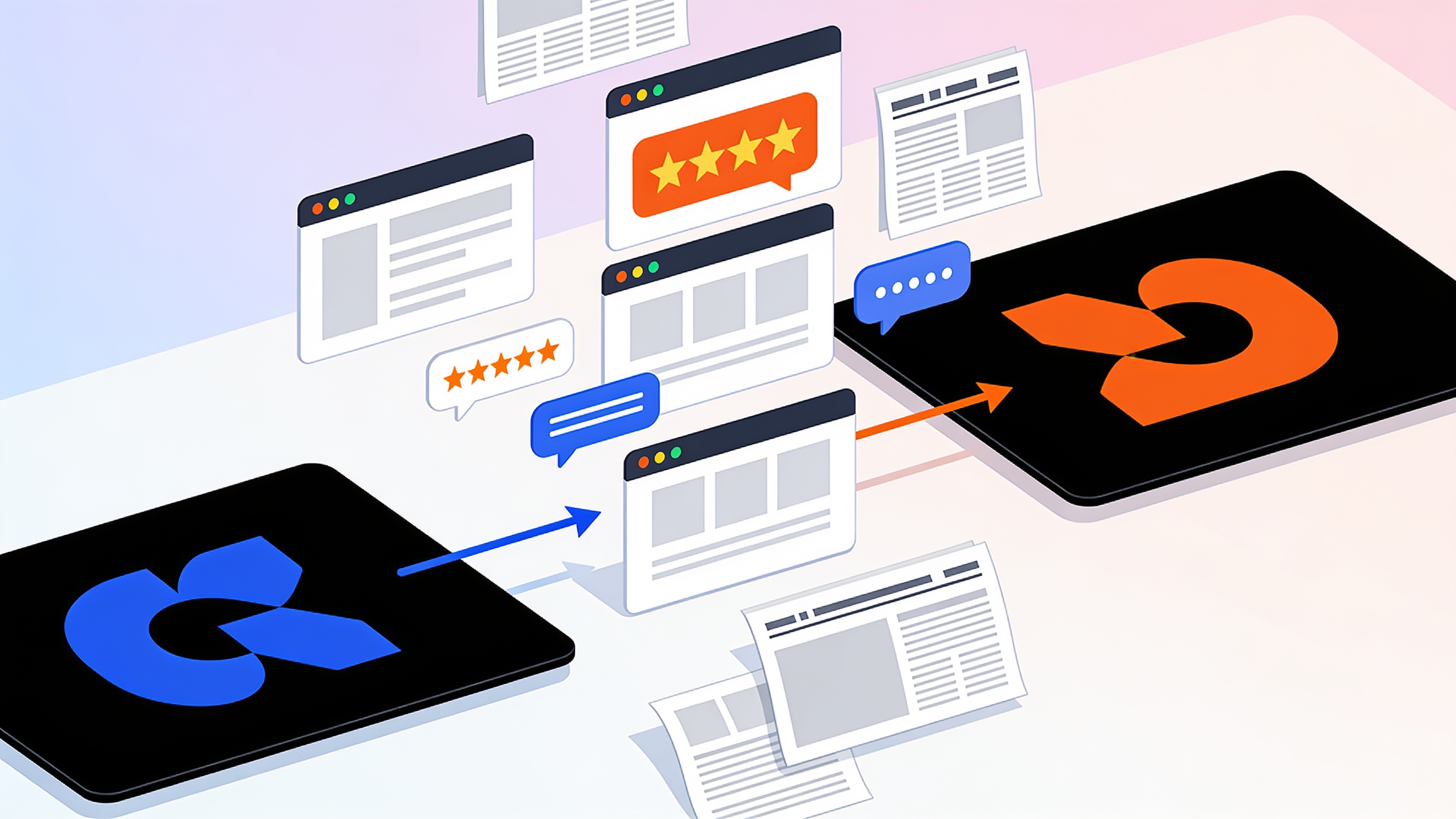
The same citation source identification process becomes a competitive intelligence tool when you substitute competitor brand names into your prompt set. Instead of category-level queries alone, run brand-specific prompts: "What are the pros and cons of [Competitor]?" or "Why do companies switch from [Competitor]?" These surface the specific third-party platforms that are actively amplifying a competitor's AI visibility — revealing gaps and platforms your brand can move on before rivals entrench further.
What to look for in a competitor footprint analysis:
- Platforms that cite your competitor but not your brand. These represent the highest-priority gaps — sources that are proven citation drivers in your category but where your brand has no established presence.
- Platforms new to the citation mix. If a trade publication that wasn't in last quarter's footprint is now appearing repeatedly for a competitor, it signals an editorial campaign worth investigating and potentially countering.
- Platform types where a competitor dominates. If a rival has strong Reddit presence and those threads consistently appear in Perplexity answers, the path forward is identifying which specific subreddits, thread formats, and problem frames are generating citations — not just "get on Reddit" generically.
- Shared sources where citation context differs. Both you and a competitor may appear on the same G2 category page — but the competitor is cited first, in the primary recommendation text, while your brand surfaces in a secondary comparison row. That context gap isas actionable as a presence gap.
An important structural note: across ChatGPT, Gemini, and Perplexity, there is only approximately 11% cross-platform domain overlap in citation sources. A competitor with strong Perplexity citations may have a completely different source footprint on ChatGPT. Segment your competitor analysis by engine — a combined aggregate view obscures the engine-specific gaps where you can actually move fastest.
Building a Presence on High-Influence Citation Sources
Once your priority influence list is built, the next step is systematically increasing your footprint across each source category. The following checklist maps platform-specific actions to the five source types in the taxonomy.
- Review platforms: Claim and fully complete your G2, Trustpilot, and Capterra profiles — including detailed feature descriptions, use-case tags, and category positioning. Respond to every review; AI engines favor profiles with active engagement signals. Trustpilot's March 2026 earnings call reported that click-throughs from AI search tools had grown roughly fifteen-fold year-on-year, confirming the platform's rising citation weight across AI engines.
- Q&A communities (Reddit): Identify the top three to five subreddits where your buyer persona asks category-level questions. Prioritize threads that already rank on Google for commercial queries — these have the engagement density that AI engines favor. Contribute substantive responses rather than promotional posts; the threads AI engines cite consistently have high upvote counts and detailed, specific answers.
- Trade publications: Cross-reference your priority influence list with editorial calendars of cited publications. Pitch bylines, expert commentary, and original data studies — AI engines strongly favor content with named expert authorship and structured lists. Analysis of cited B2B SaaS pages found that 100% used numbered or bulleted list structure and 78% carried the current year in the title. Match those patterns in every piece you place.
- Brand-owned assets: Restructure key pages to match citation-ready content patterns: numbered lists, comparison tables, current-year publication dates, and clear topical scope statements. Original research is especially powerful — sites hosting first-party data generate substantially more citation occurrences per URL than standard listing or product pages.
- Reference sources: Contribute to or expand Wikipedia pages in your category where accurate and relevant. Build relationships with analyst firms whose reports surface in AI citations for enterprise queries. For compliance-adjacent or technical categories, peer-reviewed and standards-body publications carry disproportionate citation weight across most engines.
How to Automate AI Citation Source Tracking with Mentionary
The manual methodology above is a valuable diagnostic — but running it quarterly across multiple engines and competitors creates real operational overhead. The deeper limitation is lag time: by the time a manual audit is complete, the citation landscape may have already shifted. New Reddit threads gain traction, trade publications publish category roundups, and review platforms restructure their category pages — all of which change which sources AI engines pull from when answering questions in your category.
Mentionary's citation source tracking replaces the manual query-and-record process with an always-on intelligence feed. The platform continuously queries ChatGPT, Claude, Gemini, and Perplexity with prompts drawn from your category's real buyer journey, then surfaces the specific third-party URLs appearing in AI-generated answers about your brand and category — not aggregate citation counts, but the exact pages AI engines are pulling from, updated as the citation mix changes. Change alerts fire when a new source enters or exits the mix, so you learn about a rising trade publication or a newly prominent Reddit thread before competitors do.
For teams already running citation tracking, Mentionary's source intelligence layer turns monitoring data into strategic direction: which platforms to invest in next, which competitor source gaps represent the fastest opportunities, and which content formats are most likely to earn placement on the pages AI engines are already citing. For teams starting from scratch, it's the automated version of the six-step methodology in Section 3 — running continuously rather than quarterly. If you're evaluating your options, the leading AI citation monitoring tools of 2026 offer a broader comparison of what each platform tracks and how.
- AI engines pull over 88% of their B2B SaaS citations from third-party sources — not the brand's own website.
- Reddit accounts for roughly 24% of Perplexity citations and 11% of ChatGPT citations, making it the highest-influence community source across both engines.
- G2 review volume explains less than 2% of variance in AI citation frequency — content structure and cross-web authority matter far more.
- Each AI engine has distinct source preferences: ChatGPT leans on Wikipedia and trade blogs, Perplexity on Reddit and real-time content, Gemini on YouTube and brand pages.
- Running the same citation identification process on competitor brand queries reveals which platforms are amplifying rivals — and where your brand can move first.
- Building measurable AI citation presence on high-influence third-party sources typically takes two to four months of consistent engagement.