
How to Get Your Brand Cited in Google Gemini: A Step-by-Step Optimization Guide
Learn how to get cited in Google Gemini with a step-by-step framework covering entity signals, structured data, E-E-A-T content, and citation tracking.
You've optimized for ChatGPT. You have a Perplexity strategy. You've mapped your Claude citations. But Google Gemini — the AI engine embedded directly into Google Search and reaching users across Search, Android, and Workspace — still shows a blank spot on your citation dashboard.
That gap is costing you visibility at the very top of the world's dominant search platform. Unlike ChatGPT and Perplexity, which operate as standalone AI chat products, Gemini is woven into the Google Search results page itself through AI Overviews. Every time a buyer searches a category query and gets an AI-generated answer at the top of the results, Gemini is deciding which brands to surface — and which to ignore entirely.
This guide delivers a concrete methodology for how to get cited in Google Gemini — The Gemini Citation Framework — covering the content signals, entity structures, and authority factors that control Gemini citation selection. By the end, you'll have actionable steps for each layer plus a method for measuring whether the work is producing results.
What Is Google Gemini and Why It's the Most Consequential Citation Gap for Brands
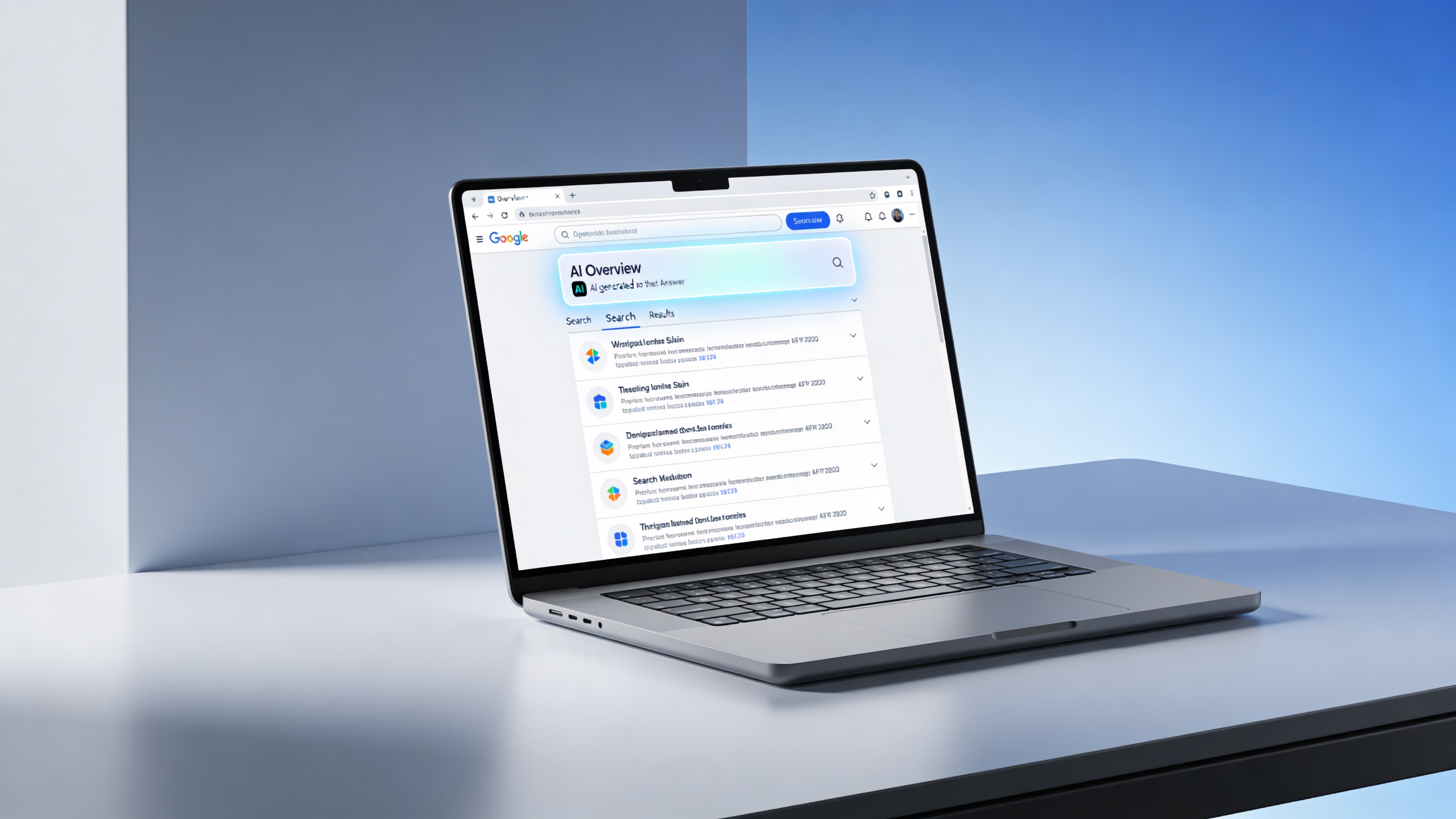
Google Gemini is Google's family of multimodal AI models powering AI Overviews in Google Search, the Gemini App, and Google Workspace. For brands, Gemini is the citation engine that controls what appears at the very top of the world's dominant search platform — making it the highest-reach surface in AI-generated answers, ahead of ChatGPT and Perplexity by total audience scale. Any brand absent from Gemini's cited sources is invisible at the moment of highest buyer intent.
Understanding how to get cited in Google Gemini requires recognizing what makes it fundamentally different from other AI answer engines. ChatGPT uses OpenAI's web-browsing layer to retrieve sources in real time against Bing's index. Perplexity runs its own crawl-and-retrieval stack. Gemini, by contrast, draws directly from Google's own Search index and Knowledge Graph — infrastructure that has no equivalent anywhere else in the AI landscape.
That distinction has enormous strategic implications. Optimizing for Gemini is not a parallel track to SEO. It is an extension of the same signals your organic rankings already depend on — but with the Knowledge Graph playing a role that has no ChatGPT or Perplexity counterpart.
The scale argument is straightforward. According to StatCounter data from March 2026, Gemini's share of AI chatbot referrals to websites has nearly quadrupled in under twelve months — rising from 2.31% in April 2025 to 8.65% by March 2026 — while Perplexity declined from 12.07% to 7.07% over the same period. Gemini has overtaken Perplexity to become the second-largest source of AI-driven referral traffic. And that measurement only captures standalone app usage, not AI Overviews impressions — which surface inside Google Search itself and represent a far larger audience than any standalone AI product.
For answer engine optimization practitioners who have already addressed ChatGPT and Perplexity, Gemini represents the single largest remaining citation gap — and the one with the most structured, measurable optimization path available.
How Google Gemini Chooses What to Cite: Sources, Signals, and Ranking Factors
Google Gemini selects citations by first identifying a candidate pool from its classical Search index, then re-ranking those candidates by extractability, source authority, content freshness, and structural clarity. This two-stage process is what makes Gemini's citation behavior more predictable — and more directly actionable — than other AI engines whose retrieval mechanics are less transparent.

Research by Stridec on Gemini's citation mechanics identifies the candidate pool as typically the top 10–20 classical SERP results for a given query, supplemented by a secondary retrieval layer that can pull from sources outside the classical top results. The critical implication: if a page doesn't rank in Google Search, Gemini cannot cite it for that query. SEO is not a parallel track — it's the prerequisite layer that determines whether your content even enters consideration.
The Knowledge Graph's Distinctive Role
The Knowledge Graph is Gemini's most consequential citation lever — one with no equivalent in ChatGPT or Perplexity. It enables Gemini to recognize your brand as a verified, disambiguated entity, attach domain prioritization to your core topics, and surface Knowledge Panel data alongside answers about your business.
Brands without a Knowledge Graph footprint — no Wikipedia entry, no claimed Knowledge Panel, weak entity signals — are systematically under-represented in Gemini's outputs on entity-related queries. This isn't an edge case. It's a structural disadvantage that affects any brand that hasn't deliberately built its entity profile.
Structured Data as an Extraction Signal
Google's official AI optimization guidance states that "structured data isn't required for generative AI search" — but that framing understates its practical impact on citation probability. Schema markup (FAQPage, HowTo, Organization, Article) gives Gemini a machine-readable map of your content's structure, intent, and entity relationships.
Pages with proper schema provide a structured extraction path that unstructured prose cannot match. Structured data doesn't guarantee citation, but it dramatically lowers the friction for Gemini to correctly extract and attribute your content when it's already in the candidate pool.
Freshness and Format Alignment
Gemini's re-ranking process weights content freshness for time-sensitive queries and applies format-query alignment across content types. According to Trakkr's Gemini citation analysis, informational queries typically receive 8–12 citations, and first-position citations consistently come from the most trusted and most extractable sources. How-to format content — numbered steps, direct answers, FAQ sections — is preferentially selected for instructional queries of exactly the type this guide targets.
Gemini vs. ChatGPT vs. Perplexity: How Citation Factors Differ Across AI Engines
The three major AI answer engines use fundamentally different retrieval architectures, meaning an optimization strategy that works for one engine does not automatically transfer to another. The comparison below maps the key citation-influencing factors — and shows why Gemini's Google infrastructure creates a uniquely structured optimization path.
| Citation Factor | Google Gemini | ChatGPT (Web Search) | Perplexity |
|---|---|---|---|
| Core retrieval mechanism | Google Search index + Knowledge Graph | Bing index + OpenAI retrieval layer | Own crawl stack + Bing index |
| Knowledge Graph weight | Very high — primary entity signal | Low — no Knowledge Graph equivalent | Low — no Knowledge Graph equivalent |
| SEO ranking dependency | Direct — SERP rank determines candidate pool | Moderate — Bing rank influences retrieval | Moderate — Bing rank + own crawl signals |
| Structured data impact | High — improves entity attachment and extraction | Medium — less directly weighted | Medium — less directly weighted |
| Recency / freshness | High for time-sensitive queries | High — real-time web browsing | Very high — prioritizes recent sources |
| Forum / review signals | Medium — weighted via Google Search indexing | High — often cites Reddit and forums directly | High — frequently surfaces forum threads |
| Google Business Profile | High for local and branded queries | Not applicable | Not applicable |
| Primary optimization lever | Entity disambiguation + SEO + schema markup | Forum presence + editorial mentions + Bing SEO | Content freshness + source authority |
The core insight from this comparison: Gemini's citation path runs through Google's own infrastructure. Every investment you've already made in SEO, structured data, and Google entity optimization has a direct upstream effect on Gemini citation probability — an efficiency advantage that neither ChatGPT nor Perplexity can offer.
The Step-by-Step Framework to Get Your Brand Cited in Google Gemini
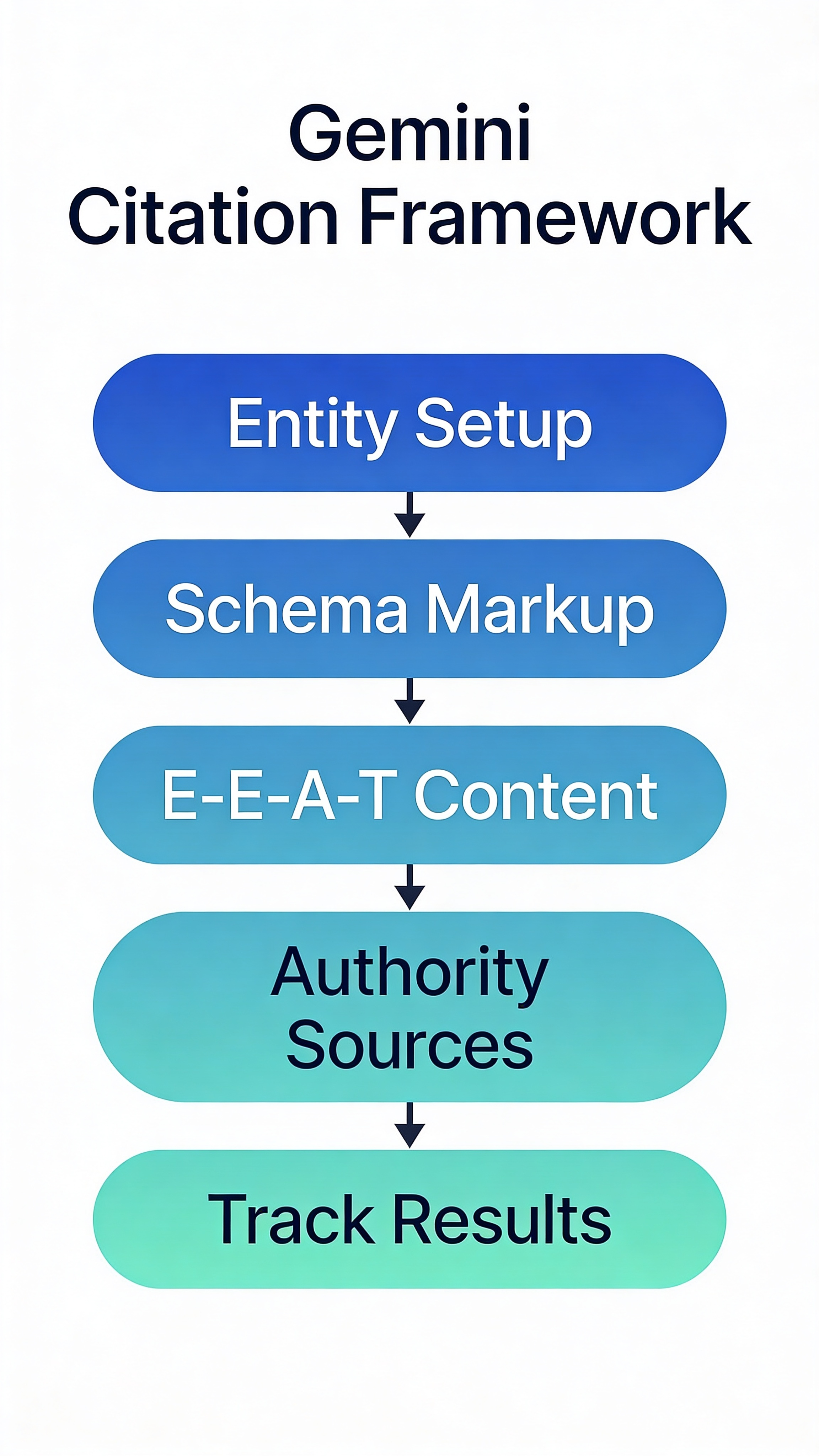
The Gemini Citation Framework is a six-step methodology that systematically addresses each layer of Google Gemini's source-selection process — from entity recognition to content extractability to third-party corroboration. Execute the steps in sequence: each layer builds on the one before it, and skipping earlier steps undermines the return on later ones.
-
Step 1: Establish and Verify Your Brand Entity
Before any content work, your brand must exist as a recognized, disambiguated entity in Google's Knowledge Graph. Claim and complete your Google Knowledge Panel if one already exists. If none exists, build toward it: ensure consistent Name-Address-Phone (NAP) data across all web properties, create a Wikipedia article or Wikidata record where your brand meets notability criteria, and list your brand in authoritative industry directories that Google treats as entity-confirmation sources.
A Knowledge Panel is visible confirmation that Google has identified your brand as a distinct entity. Without that anchor, Gemini has no stable reference point to attach your content to — citations become sporadic rather than systematic, because the engine cannot confidently attribute content to a verified brand.
-
Step 2: Implement Organization and Topic-Level Schema Markup
Deploy
Organizationschema on your homepage andArticle,FAQPage, andHowToschema on relevant content pages. These aren't just rich-results signals — they provide Gemini with a machine-readable index of your brand's identity, expertise areas, and the structure of individual pieces of content.Prioritize
FAQPageschema on pages targeting question-based queries. When Gemini evaluates multiple candidate sources for an informational query, a page with explicit FAQ markup answers the extraction task directly — reducing the inference load that causes AI engines to skip over otherwise strong content in favor of more extractable alternatives. -
Step 3: Build E-E-A-T Signals Into Your Content Architecture
E-E-A-T (Experience, Expertise, Authoritativeness, Trustworthiness) is the content quality framework Google's systems use to evaluate pages — and these signals feed directly into the authority weighting Gemini applies when selecting among candidate sources. Google's official AI optimization guidance is explicit that "non-commodity content that's helpful, reliable, and people-first" and content with "unique expert or experienced takes that go beyond common knowledge" are the characteristics most likely to improve AI visibility over time.
In practice: attribute content to named authors with demonstrable credentials, publish original data or analysis your category doesn't have elsewhere, cite primary sources inline, and structure every section with a direct answer before supporting evidence. Buried conclusions require inference — Gemini rewards explicitness.
-
Step 4: Optimize Your Google Business Profile for AI Overview Visibility
For local and branded queries, your Google Business Profile (GBP) is a direct entity-confirmation signal in Google's Knowledge Graph. Complete every profile field — services, categories, attributes, description, hours, photos — and maintain a consistent cadence of Google Posts with category-relevant content. Recent, topically aligned Posts surface in AI Overview citations for relevant local service queries.
Encourage customers to leave reviews on your GBP and respond to them consistently. Google Reviews contribute to both your Local Pack ranking and your AI Overview citation probability simultaneously, since Gemini uses review sentiment and keyword patterns to identify authoritative business recommendations when answering service-category queries.
-
Step 5: Build Third-Party Corroboration Across Authoritative Platforms
Gemini treats third-party mentions — editorial coverage, industry review sites, press citations, and directory listings — as E-E-A-T validation that no amount of on-site optimization can substitute for. Prioritize coverage in industry publications Google already treats as authoritative for your category, and actively build a review presence on platforms indexed prominently in your niche.
You can identify which third-party sources are driving citations for competitor brands in your category — and surface the gaps in your own corroboration profile — using AI citation tracking tools that monitor Gemini's source attribution patterns systematically over time.
-
Step 6: Structure Every Content Page for Direct-Answer Extraction
Format every page you want Gemini to cite for maximum extractability. Open each section with a direct 1–2 sentence answer to the target query before supporting detail. Use descriptive H2 and H3 headings that mirror the language of real search queries. Structure how-to content as numbered steps and question-based content as explicit FAQ sections with schema markup applied.
Avoid hedged openings, buried conclusions, and introductory padding that delays the answer. Gemini's extraction process rewards content that answers first and explains second — the same structure Google's featured snippet algorithm has always favored, now applied at the AI answer layer with higher stakes for brands that rely on AI-driven discovery.
How to Measure Whether You're Getting Cited in Google Gemini
Measuring your Gemini citation rate requires systematic monitoring across a defined set of category-relevant prompts — not one-off manual spot-checks that can't reveal trends or attribute changes to specific optimization actions.
Manual testing — typing individual queries into Gemini and noting whether your brand appears — is a natural starting point, but it has fundamental limitations as a measurement approach. Gemini's responses vary across sessions, surfaces (AI Overviews vs. the Gemini App), and geographic contexts. A single manual test tells you what happened once; it doesn't tell you whether your optimization work is moving the needle, which prompts drive the most citations, or how your citation share compares to competitors.
A scalable measurement approach requires four components:
- A defined prompt set: Identify the 20–50 queries your buyers actually use when researching your category. These are the citation opportunities worth tracking, not generic brand-name searches that already return your content.
- Citation frequency tracking over time: Measure what percentage of your tracked prompts return a Gemini answer citing your brand, and track this metric against specific optimization milestones to establish cause and effect.
- Competitor citation monitoring: Identify which competitors Gemini cites for prompts where your brand is absent — those gaps reveal the highest-priority content and authority deficits to address next.
- Source attribution analysis: Track which third-party sources (review platforms, publications, industry directories) Gemini draws from when it does cite you — these are the corroboration channels worth investing in for Step 5 of the framework.
Mentionary's Gemini citation tracking dashboard automates this entire measurement layer. It monitors your brand's citation rate across a defined prompt library — surfacing which query contexts Gemini is already citing you in, which competitors dominate citation share for your category, and which content and authority gaps are suppressing your visibility. Instead of manually running prompts and logging results in a spreadsheet, teams get a systematic view of citation performance that makes it possible to validate whether each step of the Gemini Citation Framework is producing measurable results.
For teams already invested in monitoring brand mentions in Google Gemini, the next step is connecting those monitoring signals back to specific optimization actions — closing the loop between citation tracking and content strategy, and turning Gemini visibility into a measurable acquisition channel.
- Google Gemini draws its citation candidates from classical Google Search results — meaning strong SEO is a direct prerequisite for Gemini visibility, not a separate optimization track.
- Brands without a Google Knowledge Panel are systematically under-represented in Gemini's entity-related answers — claiming and verifying your panel is the single highest-leverage first step.
- Structured data (FAQPage, HowTo, Organization schema) gives Gemini a machine-readable extraction path through your content, improving citation probability even though Google calls it technically optional.
- Third-party corroboration — reviews on authoritative platforms, press coverage, editorial citations — provides the E-E-A-T signals Gemini weighs most heavily when ranking brand sources.
- Gemini operates across AI Overviews, the Gemini App, and Workspace with overlapping but distinct citation patterns; AI Overviews in Google Search offers the highest-traffic optimization leverage.
- Tracking Gemini citations manually cannot scale — systematic measurement tools are required to validate whether each optimization step is actually moving your citation rate over time.