
AI Visibility Drop: Why Your Brand Disappeared from AI Answers — and How to Get Back In
An AI visibility drop means your brand stopped appearing in AI-generated answers. This guide confirms whether the drop is real, diagnoses 7 root causes, and maps each to a concrete recovery plan.
Your competitor just appeared three times in ChatGPT's answer to your core category query. Your brand? Nowhere to be found — even for prompts where you showed up consistently last quarter. Before you rebuild your entire content strategy, you need a diagnosis, not a gut reaction.
AI citation rates fluctuate constantly. Profound's 2026 longitudinal research found that 40–60% of cited domains change month to month for the same queries, and only 30% of brands remain visible across consecutive AI responses. That baseline churn is different from a real structural AI visibility drop — and conflating the two leads to the wrong fix applied to the wrong problem.
This guide gives you a structured method to confirm whether you've actually lost AI search visibility, identify which of seven root causes is responsible, and execute a targeted recovery plan mapped to each specific cause. If you're building foundational knowledge on Answer Engine Optimization and how AI citation frequency works as an acquisition channel, start there first. What follows assumes you already know the stakes and need the diagnostic playbook.
What an AI Visibility Drop Actually Is — and Why It Hits Differently Than an SEO Traffic Dip
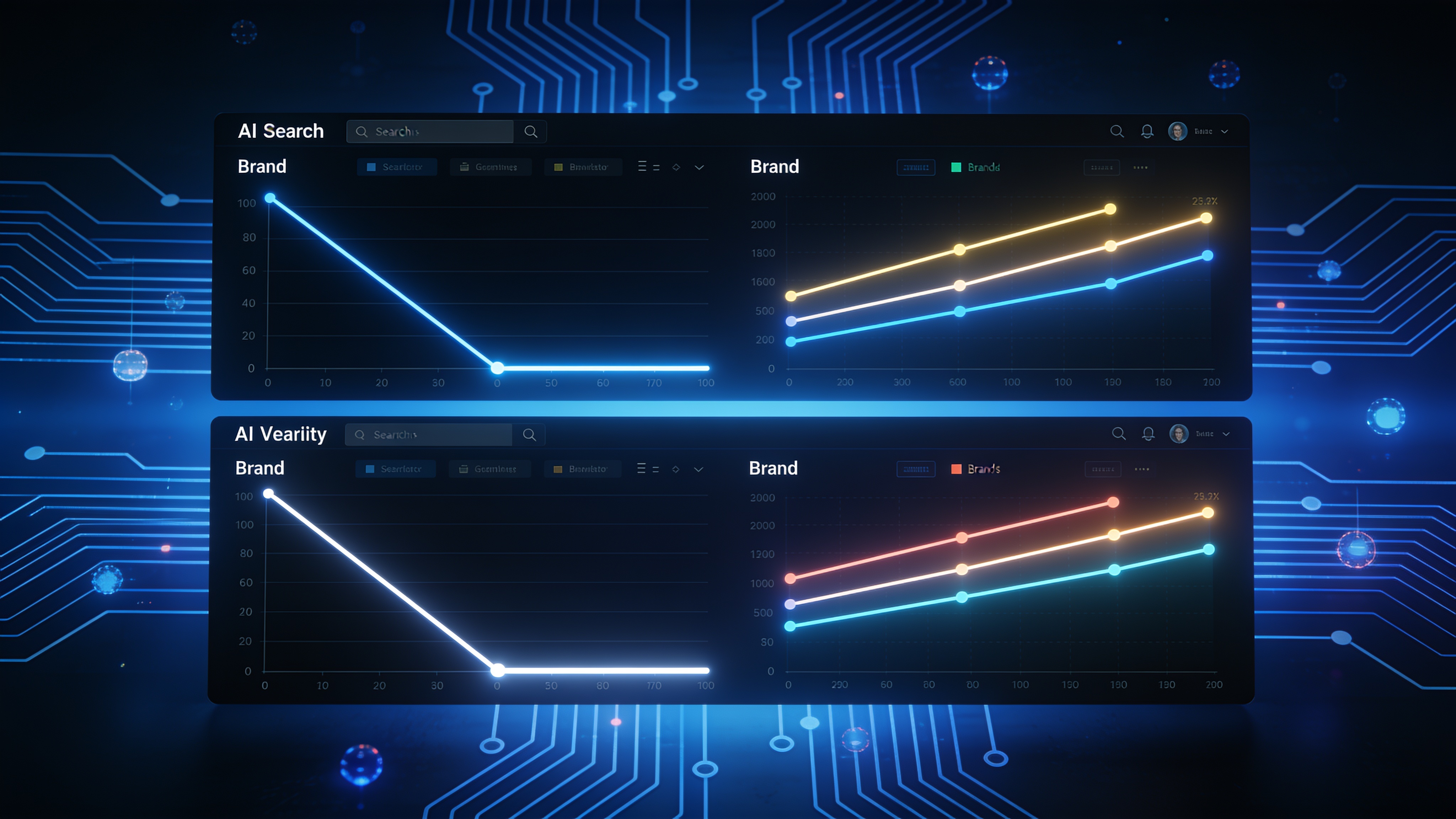
An AI visibility drop is the measurable decline in how frequently a brand is cited or recommended in AI-generated answers from engines like ChatGPT, Gemini, Claude, and Perplexity. It differs from an organic ranking fall because it can occur within days, affect multiple engines independently, and leave no indexing signal until significant share is already lost.
This asymmetry is what makes the failure mode so dangerous. A Google ranking dip shows up in Search Console within days. An AI citation drop may not surface in any existing dashboard at all — unless you're running structured citation-frequency measurement. By the time it appears in qualitative sales reports or pipeline data, weeks of compounding have already occurred.
Three properties distinguish an AI visibility drop from a standard SEO traffic dip:
- No warning signal. Unlike rank tracking, there is no native alert when your brand stops appearing in AI-generated answers. Brands typically discover drops through anecdotal evidence or a competitor audit — not a dashboard.
- Platform independence. Each engine draws from a different source pool, so a drop on ChatGPT and a drop on Gemini often have different root causes and require different fixes. They cannot be treated as one event.
- Non-linear compounding. A citation decline that starts as a 20% drop can accelerate as competitors' citation volumes reinforce each engine's model of who the category authority is — making early intervention disproportionately valuable.
How to Confirm You've Lost AI Search Visibility Before You Start Diagnosing
Confirming a drop requires structured probe testing, not a single manualcheck. A one-time observation that your brand is missing from a ChatGPT answer could mean nothing — response variability is high enough that SparkToro's methodology research recommends 60 to 100 repeated queries per prompt to reach statistical reliability. The following protocol turns noise into signal.
The Five-Step Confirmation Protocol
- Select 8–12 category-defining prompts. These should be non-branded queries your buyers actually use — "best [category] software for [use case]," "how do I solve [core problem]." Branded queries are not where citation drops hurt most; unbranded category prompts are where buying decisions happen and where displacement by a competitor is most costly.
- Run each prompt across ChatGPT, Gemini, Claude, and Perplexity separately. Only 11% of cited domains appear across multiple platforms for identical queries, which means a drop on one engine doesn't confirm a universal drop — but a synchronized drop across three engines signals a structural problem worth diagnosing.
- Log citation presence, position, and framing over at least 7 days. Record whether your brand appears, where in the response, and how it is characterized. Run three or more queries per prompt per engine per day. Use a structured AI citation tracking system to keep data organized across this volume of runs — manual spreadsheets work for initial setup but don't scale.
- Compare to a baseline period. A 30–60 day historical baseline turns this from a presence-or-absence check into a quantified measurement. Without a baseline, you can confirm current absence but not whether that absence is new or longstanding — a distinction that completely changes the urgency and the recovery approach.
- Flag the drop as confirmed when citation frequency falls more than 30% from baseline across at least two engines. A single-engine drop may reflect a platform-level reweighting event rather than anything specific to your brand. Cross-platform decline is the reliable indicator of a structural problem that warrants full root-cause diagnosis.
The 7 Root Causes of AI Citation Drops (and the Signal That Identifies Each One)
Once the drop is confirmed, the diagnostic question becomes: which root cause is responsible? Each cause has a distinct fingerprint — a specific observable signal that tells you which recovery lever to pull. Misidentifying the cause and applying the wrong fix adds weeks of wasted effort to an already compounding problem.
| Root Cause | Observable Diagnostic Signal | Est. Recovery Timeline |
|---|---|---|
| Authority Erosion | Fewer third-party editorial mentions in the last 90 days; declining brand presence in the publication types AI engines favor as citation sources | 8–16 weeks |
| Content Staleness | Key pages not refreshed in 90+ days; competitors publishing at significantly higher frequency in your category | 2–6 weeks |
| Entity Ambiguity | AI responses attribute incorrect facts to your brand, or conflate your brand with a similarly-named company, product, or person | 6–12 weeks |
| Citation-Source Deindexing | A Reddit thread, Trustpilot listing, blog post, or review page that previously cited your brand has been removed, deindexed, or substantially changed | 2–6 weeks |
| Competitor Surge | A rival appears with significantly higher frequency in the same category prompts where you've declined; their citation share grew as yours shrank over the same window | 12–20 weeks |
| Platform Reweighting | Drop is isolated to one engine and coincides with a documented platform update — as when ChatGPT's Reddit citation share collapsed from ~60% to ~10% in six weeks during September 2025 | 4–12 weeks post-stabilization |
| Brand-Name Confusion | Your brand name closely resembles another entity; AI responses in your category consistently drift toward the other entity instead of yours | 6–12 weeks |
Reading Multiple Signals Together
Most drops have a primary cause and one or two contributing factors. Running diagnostics in parallel — checking third-party mention frequency, content recency, entity query results, source-page status, and competitor citation rates — typically takes less than a day and eliminates causes quickly. The goal is to identify the primary driver first, then sequence your recovery around it.
The AI Visibility Recovery Playbook: Fixes Mapped to Each Root Cause
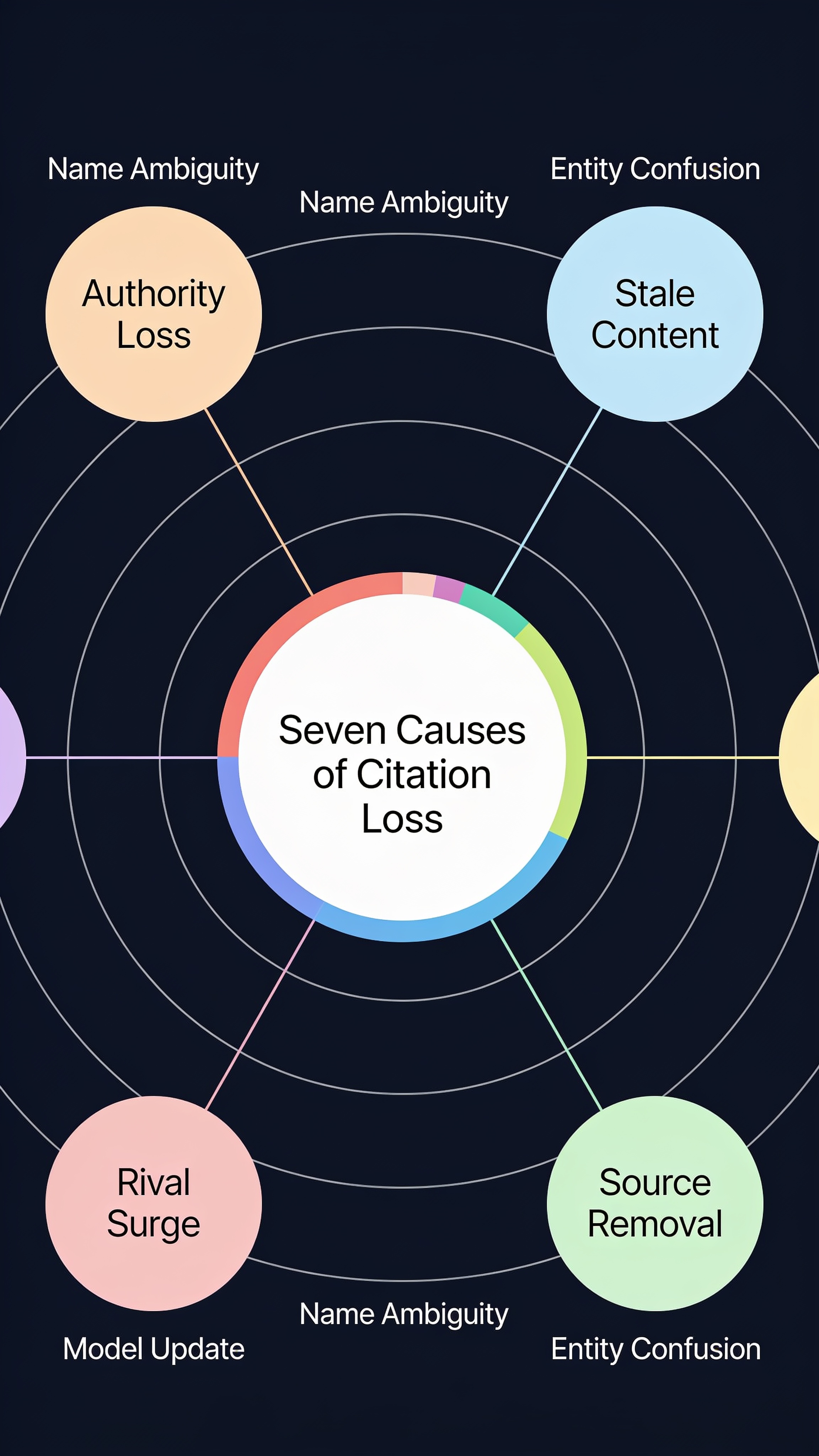
Generic advice — "create better content" — fails because AI citation drop recovery is root-cause-specific. The fix for authority erosion does nothing for a platform reweighting event. The sequences below correspond directly to the seven causes in the table above.
- Authority Erosion: Launch a sustained earned-media push targeting the source types each engine favors. ChatGPT relies heavily on Bing-indexed editorial and Wikipedia entries. Claude rewards long-form analytical content with strong outbound links. Gemini prioritizes brand-owned pages and YouTube. Perplexity rewards data-rich content in vertical directories and primary-source publications. Target 4–6 new third-party placements per month over a 12-week period and track citation frequency on a rolling 30-day basis to confirm uptick.
- Content Staleness: Audit every page that previously drove citations and refresh anything not updated in 90 days — add new data, expand comparison sections, update examples with current-year figures. Research shows content updated within 30 days earns 3.2× more AI citations across platforms — with Perplexity most sensitive, citing 30-day-old material at an 82% rate versus 37% for older content. After refreshing, re-run your probe prompts within 48 hours; Perplexity can cite updated content within hours of indexing, while ChatGPT and Gemini reflect changes more gradually.
- Entity Ambiguity: Run direct entity queries ("What is [brand name]?") across all four engines to audit how each currently describes your brand. Where descriptions are wrong or conflated, deploy organization schema and FAQ schema with precise factual claims across your site, and publish a fact-dense "About" page. Submit corrections to Wikipediaif a brand entry exists. These signals propagate to the retrieval layer over 6–12 weeks as updated pages are re-indexed and referenced.
- Citation-Source Deindexing: Identify which third-party source pages were previously driving your citations — citation-source tracking data makes this audit concrete rather than speculative. If those pages are gone, create replacement content in the same formats and publish to the same types of platforms: comparison articles, updated product reviews, refreshed case studies. Simultaneously, build owned pages that can serve as direct citation sources, reducing dependency on third-party intermediaries.
- Competitor Surge: Analyze which content types and publication platforms are driving your competitor's new citation share. Build direct-answer pages that out-depth whatever they're being cited for, target the same types of third-party publications, and publish category-comparison content that positions your brand favorably in head-to-head queries. This is the longest recovery path — 12–20 weeks — because you are competing for finite citation space within your category rather than filling an unclaimed gap.
- Platform Reweighting: When a drop is isolated to one engine and coincides with a documented platform shift, you cannot reverse the platform's decision — but you can adapt to it. After ChatGPT's September 2025 Reddit recalibration, Forbes, PR Newswire, and Medium gained citation share as Reddit and Wikipedia lost it. Monitor which source categories are now elevated on the affected engine and redirect your placement efforts there. Maintaining multi-engine presence is the structural defense: a single-engine reweighting event cannot collapse your total citation share if you're visible across all four platforms.
-
Brand-Name Confusion: Create content that makes the disambiguation explicit and factual — "Brand X is a [category] platform founded in [year], distinct from [other entity]." Publish this across your site and in third-party placements. Add structured data (organization schema) that precisely defines your entity type, industry, and founding context. If Claude specifically is showing the confusion, verify that
Claude-SearchBotis permitted in your robots.txt — blocking that crawler removes your pages from Claude's citation pool entirely, making disambiguation impossible on that engine.
Prioritizing When Multiple Root Causes Are Active
Start with the cause that is fastest to fix and most likely to produce an early measurable signal — typically content staleness or citation-source deindexing. Run authority-building in parallel since it takes longer regardless of when you start. Save competitor-surge countermeasures for after early traction is confirmed — they require sustained investment and should not displace quicker wins that restore baseline visibility first.
How to Monitor for AI Visibility Drops Before They Compound Into a Crisis
Continuous multi-engine citation monitoring is the only reliable way to catch an AI visibility drop early enough to act before it compounds. 5W's State of AI Citations 2026 documented ChatGPT's Reddit citation share collapsing from ~60% to ~10% in six weeks — with no public announcement from the platform. If that shift affected your primary citation source, a weekly manual check would have caught the decline only after 3–4 weeks of compounding. By then, competitors have reinforced their new positions and your recovery timeline has lengthened accordingly.
Why Manual Monitoring Fails at Scale
Manual probe testing works for initial diagnosis. It doesn't work as an ongoing monitoring system. The query volume needed for statistical reliability (60–100 runs per prompt), multiplied across four engines and a realistic set of category prompts, makes human-powered monitoring impractical for any team with competing responsibilities. The measurement cadence required to catch an early inflection — daily, not weekly — makes it impossible without automation.
This is the operational problem that AI visibility monitoring platforms are built to solve. Mentionary tracks citation frequency across ChatGPT, Claude, Gemini, and Perplexity continuously — surfacing not just whether your brand appears, but which sources are driving or losing citations, and how your frequency trends against competitors in the same category. When citation rate drops below a statistically significant threshold over a rolling window, the platform surfaces it as an alert alongside the source-change data that points toward the likely root cause — so you're diagnosing from data, not from a hunch.
That early signal is what separates a two-week recovery from a four-month one. The field of AI citation monitoring tools has grown substantially in 2026, but the core capability required stays the same: cross-engine tracking at sufficient query volume to be statistically meaningful, with drop detection that fires before the decline has compounded into a structural deficit that takes quarters to reverse.
- An AI visibility drop is a measurable decline in citation frequency across AI engines — it operates independently of Google rankings and can occur within days without any visible warning signal.
- Statistical confirmation requires at least 60 repeated query runs per prompt — single-pass snapshots are too noisy to distinguish a real drop from prompt-phrasing variance.
- Only 11% of domains are cited by both ChatGPT and Perplexity for identical queries, meaning a drop on one platform rarely signals a universal visibility problem.
- Content updated within 30 days earns 3.2× more AI citations on average — content staleness is the fastest root cause to diagnose and typically the fastest to address.
- Platform reweighting events — like ChatGPT's Reddit citation share collapsing from ~60% to ~10% in six weeks in 2025 — can drop brands with no action required on the brand's part.
- When multiple root causes are active simultaneously, prioritize the fastest-to-fix first while running authority-building in parallel — it takes longer regardless of when you start.