
How Reddit, G2, and Trustpilot Drive AI Citations — and How to Build Your Brand's Third-Party Presence
Reddit, G2, and Trustpilot drive AI citations more than brand websites. Learn which third-party platforms matter and exactly how to build your presence on each.
When ChatGPT or Perplexity recommends a vendor in your category, it rarely learned that from the brand's homepage. It learned it from a Reddit thread where someone asked for recommendations, a G2 review page comparing the top options, or a Trustpilot listing with fifty verified customer responses. This isn't accidental — it's structural. AI engines are built to cite sources that appear independent, high-volume, and community-validated. If you've already optimized your own website for answer engine optimization and still aren't appearing in AI answers, your off-site presence is the gap.

Why AI Engines Trust Third-Party Sources More Than Your Own Website
AI engines treat your own website as a biased source by design. Your homepage tells the model what you want buyers to believe. Reddit threads, G2 reviews, and Trustpilot listings tell the model what buyers actually experienced — and AI engines are explicitly trained to weight independent, community-sourced corroboration over self-published brand claims.
This dynamic has a straightforward logic: when multiple independent sources converge on the same claim about a vendor, AI models assign that claim higher confidence. A brand page asserting "best-in-class onboarding" is a single self-interested assertion. Five G2 reviews and three Reddit threads describing the same experience create a corroboration signal AI engines cannot ignore — and frequently surface in answers.
The strategic implication is significant: the content that most reliably earns you AI citations is often content you didn't write yourself. That shifts the optimization priority from publishing more on your own domain to seeding, encouraging, and structuring third-party content on the platforms AI engines demonstrably read. The sections below map exactly which platforms those are — and how to build authority on each one.
How ChatGPT, Perplexity, and Gemini Use Reddit, Review Sites, and Forums
The three major AI answer engines handle third-party content differently. Understanding those differences is what separates a generic "build a presence everywhere" recommendation from a prioritized, engine-specific strategy.
Perplexity: Where Reddit AI Citations Dominate
Perplexity has the heaviest reliance on Reddit of any major AI engine. According to Similarweb's analysis of AI citation patterns, Reddit appears in 46.7% of Perplexity responses — making it the single most cited UGC platform for that engine. Perplexity's retrieval-first architecture naturally surfaces community discussions where real users share vendor experiences, software comparisons, and category recommendations. If buyers in your category are asking Perplexity for options, Reddit coverage is your highest-leverage off-site investment. For a deeper look at how to monitor your brand mentions in Perplexity, the fundamentals apply directly to the third-party platforms covered here.
ChatGPT: Where Review Sites Carry More Weight
ChatGPT weights Reddit significantly less than Perplexity does. The same Similarweb analysis found Reddit at just 5.3% of ChatGPT citations, where editorial and structured platform data prevails instead. For commercial queries — comparisons, alternatives, category recommendations — ChatGPT tends to pull from structured review platforms like G2 and Capterra, which present aggregate ratings, pros/cons lists, and verified reviewer language in a format AI models can parse efficiently. Optimizing your review platform presence is the higher-ROI move for ChatGPT specifically.
Gemini and Google AI Overviews: A Mixed Signal
Gemini draws heavily on both review platforms and Reddit simultaneously. Research by SE Ranking found that review platforms appear in roughly 34.5% of Google AI Overviews — with an average of 2.28 review platform links per response. Reddit appears in 21% of AI Overviews, reinforcing that community content matters even within Google's own AI layer. Brands that build presence on both review platforms and relevant Reddit communities benefit from the broadest coverage across Gemini's citation sources.
Across all three engines, UGC and community platforms collectively drive nearly half of all citations in AI search, per an analysis of 5.5 million AI-generated answers. This scale makes third-party content strategy non-optional for any brand serious about AI visibility in 2026.
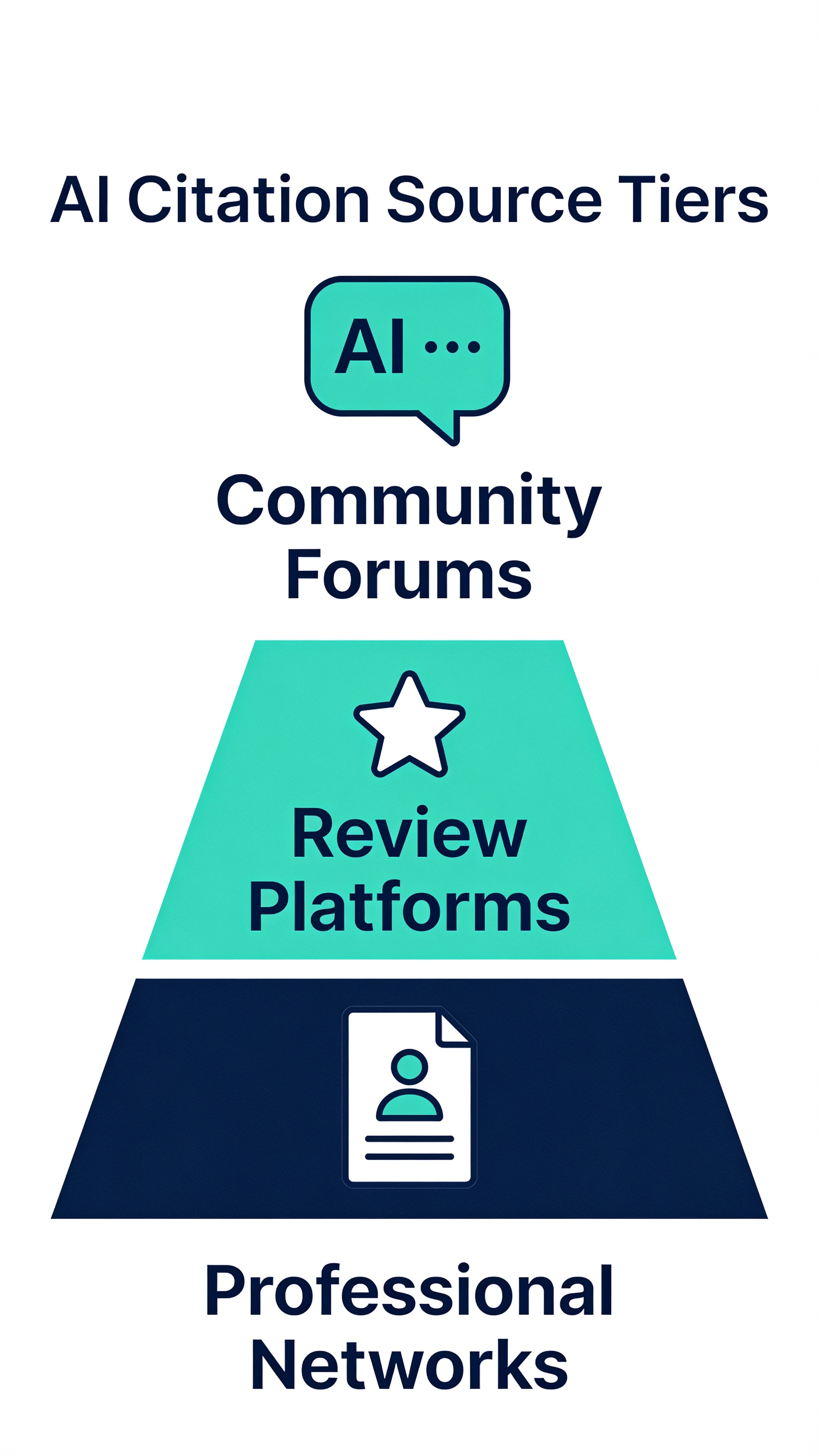
The Third-Party Platforms That Drive AI Citations: Ranked by Impact
Not every external platform carries equal weight with AI engines. The table below maps the major third-party content sources to their primary content type, best-fit audience, and observed AI citation strength — so you can prioritize effort against your specific category and target engine.
| Platform | Primary Content Type | Best-Fit Audience | AI Citation Strength & Notes |
|---|---|---|---|
| Discussion threads, category comparisons, vendor advice | B2B tech, SaaS, consumer software, and most general categories | Very High. Appears in 46.7% of Perplexity responses; 21% of Google AI Overviews. Lower on ChatGPT (5.3%) but still influential as corroborating signal. | |
| G2 | Verified user reviews, category grid rankings, comparison pages | B2B software and SaaS | High. Accounts for 23.1% of all review platform citations in Google AI Overviews. Functions as a trust gate for AI engines evaluating B2B software vendors. |
| Capterra | User reviews, feature comparisons, pricing guides | B2B software — SMB and mid-market | High. 17.8% of review platform citations in AI Overviews. Now under G2's ownership following the February 2026 acquisition, amplifying its combined citation authority. |
| Trustpilot | Customer reviews, brand trust scores | B2C, services, and B2B e-commerce | Moderate–High. Strong for consumer and service businesses; provides the trust-signal layer AI engines use for brand credibility outside pure SaaS categories. |
| Thought leadership articles, company pages, professional discussion | B2B — professional services, enterprise | Moderate–High. Surged to prominence in ChatGPT citations for professional queries by early 2026. Increasingly important for enterprise and services categories. | |
| Industry Blogs & Vertical Forums | Expert roundups, vendor comparisons, category analysis | Vertical-specific (varies by niche) | Variable. High when the publishing domain itself has strong authority; effective as a supplement to the platforms above rather than a standalone strategy. |
Sources: Similarweb, SE Ranking, MaxAEO
How to Build a Reddit Presence That AI Engines Actually Cite
Reddit's citation power comes directly from the authenticity of its content — and that authenticity is enforced by community norms that penalize promotional behavior. The 90/10 rule (90% genuine community participation, 10% or less self-promotion) isn't just a platform guideline — it's what produces the kind of content AI models are trained to treat as high-quality, trustworthy signal. Gaming Reddit with low-effort posts does the opposite of what you want.
Follow these steps to build the type of Reddit presence that generates lasting AI citation value:
- Identify the right subreddits for your category. Search Reddit for your product category, core pain points, and competitor names to find where buyers already gather. For B2B SaaS, communities like r/SaaS, r/Entrepreneur, r/smallbusiness, and vertical-specific subreddits (r/marketing, r/devops, r/webdev) are common starting points. Prioritize subreddits with recent, active discussions — stale communities are less likely to surface in AI retrieval.
- Build account credibility before any brand-related activity. Per Reddit's self-promotion guidelines, moderators inspect posting history before actioning brand-related content. Spend two to four weeks genuinely contributing: answering questions in your expertise area, joining discussions, upvoting quality content. A brand-new account with zero history that immediately promotes a product is the fastest path to a shadow ban.
- Use personal accounts with disclosed affiliation — not corporate handles. Brand-named accounts are a structural disadvantage in most communities. A personal account where you openly disclose "I work at [company]" consistently outperforms corporate handles on both trust and engagement. Disclosed participation is also far less likely to trigger moderator removal or shadowbans.
- Answer questions where your product is a genuine solution. The threads AI engines surface are those where a recommendation is clearly warranted and the answer provides real specificity. When someone asks "what's the best tool for X?" in a relevant subreddit, a thoughtful response that includes your product among legitimate alternatives is far more AI-citation-worthy than a thread you created yourself.
- Target comparison and "alternatives to" threads specifically. Posts like "Tool A vs. Tool B" and "alternatives to [competitor]" are disproportionately cited by AI engines because they exactly match the query patterns buyers type into ChatGPT and Perplexity. Find these threads and add substantive comparative context — including your product where honest and appropriate.
- Host branded AMAs with moderator pre-approval. Structured AMAs — scheduled in advance, approved by moderators, posted from an account with genuine participation history — generate high-authority Reddit content that AI engines frequently surface for brand and category queries. The content stays indexed indefinitely and accumulates votes over time, increasing its citation probability.
Turning G2, Trustpilot, and Capterra Reviews into AI Citation Fuel
Review platforms act as a trust gate for AI recommendations. According to research by MaxAEO, before ChatGPT or Perplexity mention a software vendor, they effectively verify the vendor's presence and structured description across review platforms. A missing or thin profile isn't just a missed marketing opportunity — it's an active exclusion signal. Building robust review platform coverage is infrastructure for AI visibility, not supplementary marketing.
Use this checklist to maximize the AI citation value of your review platform presence:
- Claim and fully complete profiles on G2, Trustpilot, and Capterra. Every field you fill in — category tags, feature lists, integrations, use case descriptions — is structured data AI engines can extract and attribute to your brand. Incomplete profiles reduce the signal surface these platforms expose to AI models.
- Categorize yourself accurately and specifically. AI engines use category tags to determine which vendors appear in comparison queries. A category label that is too broad ("business software") or missing entirely means exclusion from the narrower evaluative queries where buyers are actively shortlisting vendors.
- Drive review volume through systematic post-onboarding sequences. G2's 2025 Buyer Behavior Report found that GenAI chatbots are now the #1 source influencing B2B vendor shortlists at 17.1%, with review sites following at 15.1%. The two reinforce each other: reviews improve AI citation frequency; AI citations drive discovery that feeds more reviews.
- Coach customers toward specific, keyword-rich review language. AI engines extract reviewer language directly. A review that says "we replaced [Competitor] with [Your Product] because the analytics dashboard cut our weekly reporting time in half" creates attribution signals AI models use when buyers ask comparison or use-case questions. Generic praise ("great product, easy to use") creates almost none.
- Respond publicly to every review — including critical ones. AI engines read vendor responses as additional brand context. A detailed, substantive response to a critical review demonstrates product sophistication and customer commitment in ways that raw review scores alone cannot communicate.
- Maintain review recency with a quarterly cadence. AI engines weight recent content more heavily than stale data. A steady stream of new reviews every quarter outperforms a historical burst from two years ago — even if the older reviews outnumber the newer ones.
- Monitor competitor review profiles for content gaps. If competitors are appearing in AI answers for your category and you are not, their review profiles are a useful reverse-engineering target: which use cases do their reviews address that yours don't? Which comparison threads cite them and not you?
How to Track Which Third-Party Sources Are Actually Driving Your AI Citations
Building a third-party presence is only half the work. The harder challenge is understanding which of those investments are actually translating into AI citations for your brand — and which platforms are generating engagement without ever appearing as sources in AI-generated answers. Without measurement, third-party content strategy is guesswork.
You might be generating significant Reddit engagement in communities that ChatGPT rarely retrieves from, while your category's actual AI citations are flowing through a review platform you've treated as low priority. Reallocating effort requires knowing what's working now — not inferring it from general platform statistics.
Citation source tracking makes this measurable. Tools that systematically query AI engines, capture their source citations, and map those citations back to specific domains give marketers a ground-truth view of which platforms are contributing to brand recommendations in real time. This is precisely what AI citation tracking is designed to surface: not just whether your brand is cited, but where those citations are coming from and which third-party content is driving them.
Mentionary's citation source tracking feature identifies exactly which third-party platforms — specific Reddit threads, G2 review pages, Trustpilot listings, industry blog posts — are being cited when AI engines respond to queries in your category. Rather than assuming that a strong G2 profile is driving AI mentions, you can see which sources are actually being surfaced, how frequently, and in what competitive context relative to your rivals.
The output is actionable: if Perplexity is citing three Reddit threads about your category but none mention your brand, that is a specific gap with a specific fix. If G2 is being cited but competitor profiles rank above yours in AI answers, that is a review volume and recency problem with a concrete remediation path. You can also use AI citation monitoring tools to benchmark your third-party presence against competitors across all major AI engines simultaneously.
The brands winning AI citations in 2026 aren't just publishing more content. They're measuring which external platforms drive attribution and concentrating effort on the channels that demonstrably move the needle — then closing the gaps their competitors haven't found yet.
- Reddit appears in 46.7% of Perplexity responses — making it the single most cited UGC platform and indispensable for any brand targeting AI-driven discovery.
- G2 and Capterra together account for over 40% of all review platform citations in Google AI Overviews, functioning as a trust gate AI engines verify before recommending vendors.
- UGC and community platforms collectively drive nearly half of all citations across major AI engines, per analysis of 5.5 million AI-generated answers.
- ChatGPT weights structured review site data more heavily than Reddit for commercial queries — a distinction that should shape your platform prioritization by AI engine.
- G2's February 2026 acquisition of Capterra, Software Advice, and GetApp concentrated B2B review authority into a single entity, amplifying the strategic value of a strong G2 profile.
- Building third-party presence without citation tracking means operating blind — you cannot optimize the channels that are actually moving the needle if you cannot measure them.