
AI Conversational Brand Monitoring: Track Every AI Engine
ChatGPT doesn't send alerts when it recommends a competitor instead of you. AI conversational brand monitoring closes that gap — covering ChatGPT, Gemini, Perplexity, and Claude.
When a potential customer asks ChatGPT "what's the best project management software for remote teams?" — does your brand appear in the answer? For most businesses, the honest answer is: they have no idea. That's exactly the gap AI conversational brand monitoring is designed to close.
Traditional brand monitoring scans publicly indexed content: news articles, social posts, review pages, and forum threads. That model worked well when every influential piece of content had a stable URL a crawler could visit. In 2026, that assumption no longer holds. Millions of buying decisions now start with a question typed into an AI chat interface — and those answers are session-based, never indexed, and invisible to conventional monitoring tools.
This guide explains what AI conversational brand monitoring is, which platforms matter most, and how to build a monitoring program that actually covers this channel. If you're new to this space, understanding how brand mentions work across AI platforms provides essential grounding before you start instrumenting them.
What Is AI Conversational Brand Monitoring?
AI conversational brand monitoring is the practice of systematically tracking whether and how your brand appears in responses generated by AI chat tools — including ChatGPT, Perplexity, Gemini, and Claude — when users ask product, category, or problem-solving questions.
Unlike traditional brand monitoring, which records every public mention of your brand name on the web, AI conversational brand monitoring asks a different question: when an AI engine synthesizes an answer in your category, does it name you?
The distinction matters because AI engines don't surface every brand that could be relevant. They compose an answer and name a short list — often two to four options — based on training data, retrieval context, and citation patterns. A brand not named in that answer is effectively invisible to that user at that moment.
Three things make this channel distinct from every monitoring approach that came before it:
- Generative, not index-based. AI answers are composed on demand, not pulled from a stable index. The same question asked twice can yield different brands depending on retrieval context and model behavior.
- Conversational query structure. Users ask in natural language. Brand visibility depends on how the AI interprets intent, not on keyword matching against a fixed document set.
- Invisible by default. There is no notification when ChatGPT recommends your competitor instead of you. You only know if you are actively watching.
Why Traditional Brand Monitoring Tools Miss AI Answers
Traditional brand monitoring tools are architecturally blind to AI-generated answers because those answers are session-based, never indexed, and require active querying rather than passive crawling. Google Alerts, Mention, and Brandwatch were built to crawl stable, publicly accessible URLs — a model that breaks completely when the content is generated on demand inside a chat session and exists only for that user, in that moment. They find articles, social posts, forum threads, and review pages containing your brand name. That architecture worked perfectly when every influential piece of content had a stable URL a crawler could reach.
AI-generated answers don't work that way. When a user asks Perplexity "which accounting software is best for freelancers?" the response exists only in that session. It isn't indexed. It has no URL a crawler can visit. Standard monitoring tools are architecturally blind to it.
The scale of this gap is significant. Research published by Search Engine Journal, based on a study by Victorious and SPA, found that AI recognizes 96% of brands — but mentions only a small fraction of them when synthesizing category answers, according to research by Victorious and SPA published by Search Engine Journal. Recognition and recommendation are entirely different things, and traditional tools only capture the latter when it appears in crawlable content. The recommendation layer is missed entirely.
Three specific gaps make traditional tools structurally inadequate for this channel:
- No session capture. AI answers are transient. They must be queried and recorded at the moment they're generated — there is no archive to crawl after the fact.
- No prompt simulation. Monitoring AI visibility requires actively sending queries that represent your buyers' actual questions and recording whatcomes back. Passive crawling cannot do this.
- No competitive context. You need to know not just whether you appear, but which competitors appear alongside you — or instead of you — for each query type.
This structural gap is also why optimizing for LLM search differs fundamentally from traditional SEO — the signals that drive AI recommendations are different, so the monitoring infrastructure must be different too.
The Four AI Engines Where Your Brand Gets Named or Ignored
The four AI engines where your brand is named or ignored — ChatGPT, Perplexity, Gemini, and Claude — each make brand recommendation decisions independently, based on distinct training data, retrieval architectures, and citation behaviors that make cross-engine monitoring the only way to capture a complete picture of your AI brand presence.
Not all AI chat platforms drive the same purchase intent or citation behavior. Here is how the four dominant engines compare for brand visibility monitoring purposes, based on their usage patterns and answer architectures as of 2026.
| AI Engine | Primary Use Case | Source Citation Behavior | Monitoring Priority |
|---|---|---|---|
| ChatGPT | General research, product discovery, task completion | Limited citations in standard mode; more with Search enabled | Highest — dominant market share for purchase research queries |
| Perplexity | Research-focused queries, fact verification, comparison searches | Always cites sources; inline links create a direct referral traffic path | High — heavy commercial research intent; citations can drive direct visits |
| Google Gemini | Search-integrated queries, local discovery, shopping research | Integrates with Google Search; surfaces related search links | High — embedded in Google's search experience, reaching passive searchers |
| Claude | Analysis, writing assistance, professional vendor research | Minimal citations; trained on broad web corpus | Medium — growing use for professional purchase research and B2B vendor evaluation |
Your category and audience will determine which engines to prioritize. B2B software buyers increasingly use Perplexity for vendor shortlists because its inline citations let them jump directly to reference pages. Consumer product categories may see more brand-shaping influence from ChatGPT's high-volume general queries. Monitoring all four gives you the complete picture — omitting any one of them creates a blind spot.
How to Set Up AI Conversational Brand Monitoring in 5 Steps
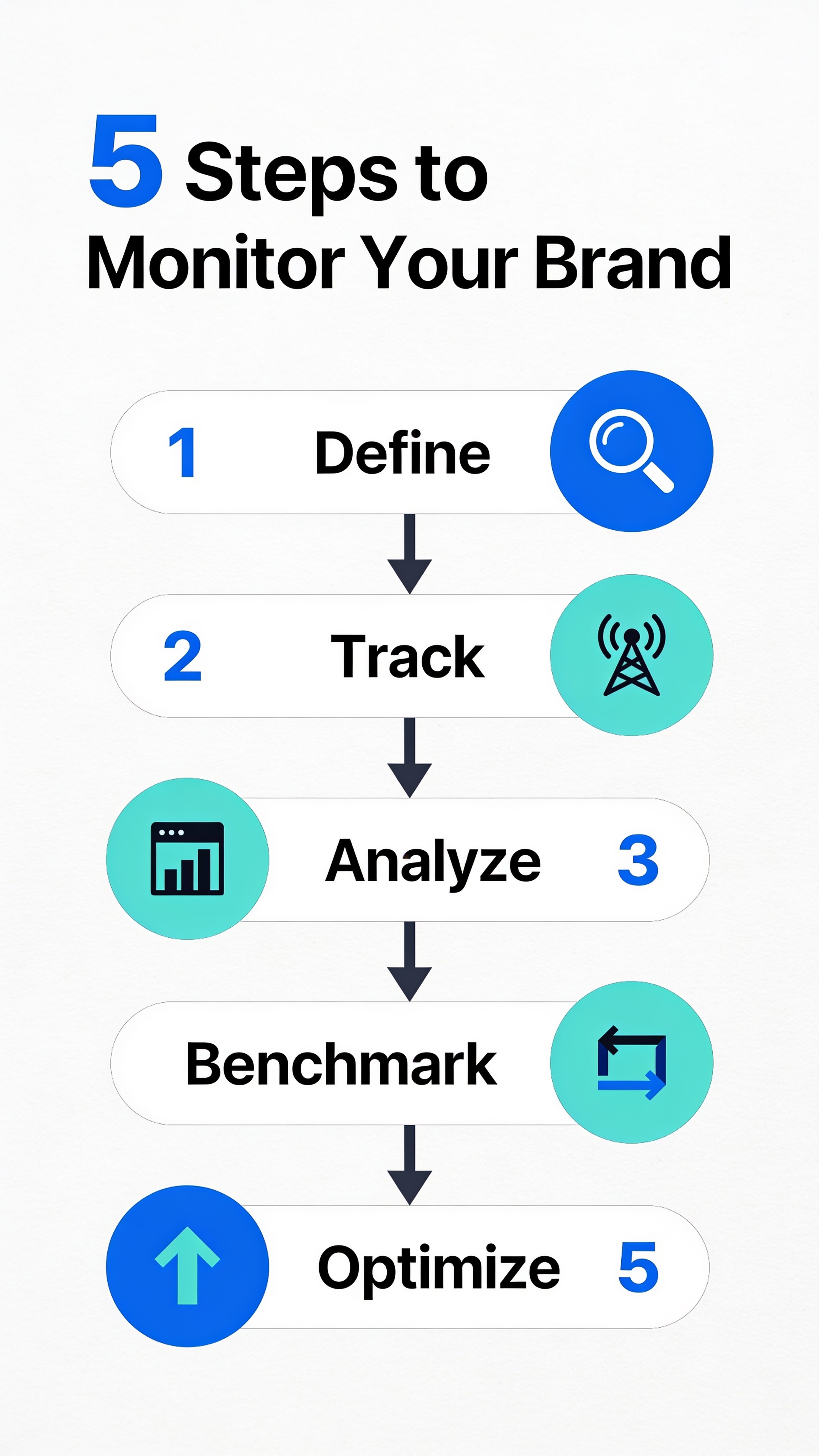
Setting up AI brand monitoring is achievable within a few days once you have the right tool and a defined query set. These five steps apply whether you're starting from scratch or migrating away from manual spot-checking.
-
Define Your Query Set
Define your tracked query set. List the 20–50 questions your ideal buyers are most likely to ask an AI engine when researching your category. Include problem-framing questions ("how do I solve X"), category questions ("best tools for Y"), and comparison questions ("X vs Y for Z use case"). These become your permanent monitoring inputs — revise them quarterly as your product and market evolve.
-
Select and configure your monitoring tool. Choose a dedicated AI monitoring platform that queries your target engines on a defined schedule. Set your brand name, your competitor list, and your tracked query set. Configure email or Slack alerts for significant changes in mention rate or sentiment scoring so you're notified of important shifts without manually checking dashboards.
-
Establish your baseline. Run your full query set across all monitored engines and record your brand's mention rate, average sentiment, and competitive share of voice for each query. This baseline is your benchmark — every future measurement is relative to it, and without it, you cannot tell whether changes are meaningful or noise.
-
Schedule regular monitoring cycles. Most teams run daily automated queries and review weekly summaries. High-volume or high-competition categories may warrant real-time alerting. At minimum, review results whenever you publish significant new content, change your positioning, or a competitor makes a major product announcement. For a full walkthrough of configuring thresholds and routing notifications, see how to set up real-time AI brand mention alerts.
-
Optimize Based on Findings
Optimize based on what you find. Use low-mention queries to identify content and authority gaps. If your brand never appears when users ask "what's the best solution for X" but a competitor consistently does, that's a direct content-building signal. Create authoritative content that answers that query directly, build third-party citations from credible sources, and re-monitor after 30–60 days to measure the impact.
What to Look for in an AI Brand Monitoring Tool
The right AI brand monitoring tool must do more than issue occasional queries — it must record results systematically, track trends over time, and surface competitive intelligence that shapes strategy. Here are the capabilities that separate effective tools from superficial ones.
Must-Have Capabilities
Must-have capabilities for any AI brand monitoring tool:
- Multi-engine coverage. At minimum: ChatGPT, Perplexity, Gemini, and Claude. Tools that only cover one or two engines give an incomplete — and potentially misleading — picture of your AI brand visibility.
- Automated scheduled queries. Manual spot-checking is not monitoring. The tool must run your full query set on a defined schedule, at minimum daily, without requiring manual intervention each cycle.
- Trend tracking and historical data. You need to see whether your mention rate is rising or falling over weeks and months, not just what it is today. Historical data is what turns monitoring into actionable insight.
- Competitive benchmarking. Your share of voice relative to named competitors is as important as your absolute mention rate. A 40% mention rate looks very different if your top competitor sits at 80% versus 15%.
- Sentiment and context analysis. Whether the AI mentions your brand positively, neutrally, or negatively — and in what context — is critical. A negative characterization in an AI answer can be worse than no mention at all.
Purpose-Built Tools to Evaluate
Purpose-built tools in this space include Otterly.AI, which starts at €29/month on the Lite plan with unlimited brands and competitors, scaling to €189/month (Standard, with API access) and €489/month (Premium). Peec AI offers cross-engine coverage starting at $95/month (Starter), through $245/month (Pro) and $495/month (Advanced), with sentiment scoring across ChatGPT, Perplexity, Claude, Gemini, Meta Llama, and Deepseek. Both platforms were built specifically for AI visibility monitoring — their query engines and reporting are purpose-designed for this use case rather than retrofitted onto existing social listening infrastructure.
Mentionary was designed for teams that need AI brand monitoring without the overhead of enterprise platforms. Rather than patching AI visibility onto a traditional tool, Mentionary's core architecture was built for AI engines fromday one — covering ChatGPT, Perplexity, Gemini, and Claude in a single dashboard, with query-level context showing not just whether you were mentioned, but what the AI said about you and which competitors appeared alongside you in each answer.
When evaluating any tool, the most useful question isn't "which engines does it cover?" — it's "can I see the actual AI answer that mentioned or omitted my brand, and can I track that trend over time?" Mention rate alone is a vanity metric. Context and trend are what drive decisions.
AI conversational monitoring is now a foundational layer of brand strategy, not an optional add-on. For teams building a full-stack approach, a comprehensive brand monitoring strategy covers how AI and traditional channels work together as a unified visibility program.
- AI conversational brand monitoring tracks whether your brand appears in AI-generated answers — a channel traditional social listening and web crawlers cannot see
- ChatGPT, Perplexity, Gemini, and Claude offer no native brand mention tracking; dedicated third-party tools are required
- AI engines recognize most brands but recommend very few — appearing in a generated answer requires more than simply being known
- A five-step program — define queries, configure a tool, establish a baseline, schedule monitoring, then optimize — can be live within days
- Purpose-built monitoring tools such as Otterly.AI (from €29/month) and Peec AI (from $95/month) cover multi-engine tracking with competitive benchmarking